

India's Q4 GDP slumps to 9-year low
 India's
economic growth faltered further in the last three months of the fiscal
year 2011-12, as the manufacturing sector registered a decline in output
and agriculture growth slowed even as the services sector held its own.
A sticky inflation, aggressive monetary tightening by the RBI, policy
stalemate and a global slowdown have crimped corporate investments and
consumer spending over the course of FY12. The Gross Domestic Product
(GDP) grew by 5.3% in the January to March quarter of FY12 from the year-ago
period, after expanding by 6.1% YoY in the third quarter, the Government
said in a statement today. India's GDP growth in the second quarter stood
at 6.7% while the same in the first quarter was at 8%. India's GDP grew
by an impressive 9.2% in the fourth quarter of FY11. Economists had forecast
a GDP growth of 6.1% in Q4 FY12. This is the lowest GDP growth in nine
years. The Indian economy expanded by 6.5% in the year ended March 31,
2012 as against the Government's provisional forecast of 6.9%, the CSO
data showed today. India's GDP grew by 8.4% in FY11. The Government expects
India's economy to grow by 7.6% in FY13...Read
More
India's
economic growth faltered further in the last three months of the fiscal
year 2011-12, as the manufacturing sector registered a decline in output
and agriculture growth slowed even as the services sector held its own.
A sticky inflation, aggressive monetary tightening by the RBI, policy
stalemate and a global slowdown have crimped corporate investments and
consumer spending over the course of FY12. The Gross Domestic Product
(GDP) grew by 5.3% in the January to March quarter of FY12 from the year-ago
period, after expanding by 6.1% YoY in the third quarter, the Government
said in a statement today. India's GDP growth in the second quarter stood
at 6.7% while the same in the first quarter was at 8%. India's GDP grew
by an impressive 9.2% in the fourth quarter of FY11. Economists had forecast
a GDP growth of 6.1% in Q4 FY12. This is the lowest GDP growth in nine
years. The Indian economy expanded by 6.5% in the year ended March 31,
2012 as against the Government's provisional forecast of 6.9%, the CSO
data showed today. India's GDP grew by 8.4% in FY11. The Government expects
India's economy to grow by 7.6% in FY13...Read
More
Manufacturing, Agriculture drag down FY12 GDP: CARE Ratings
 The
Central Statistical Office (CSO) has released revised estimates of GDP
for Q4 FY12 and annual estimates for the fiscal year FY12. There has been
a downward revision in GDP growth rate, from 6.9% (advance estimates)
to 6.5% (revised estimates) in FY12, consequent on muted performance in
manufacturing and the services segment of hotels, transport and communication.
The
Central Statistical Office (CSO) has released revised estimates of GDP
for Q4 FY12 and annual estimates for the fiscal year FY12. There has been
a downward revision in GDP growth rate, from 6.9% (advance estimates)
to 6.5% (revised estimates) in FY12, consequent on muted performance in
manufacturing and the services segment of hotels, transport and communication.
Annual Estimates – GDP growth in FY12
Overall GDP growth has slowed down from 8.4% in FY11 to 6.5% in FY12, with growth in mining being negative and growth in manufacturing being as low as 2.5% in FY12 (as against 7.6% in FY11)
Drag downs
Agriculture has registered considerable decline in growth from 7.0% in FY11 to 2.8% in FY12. This may be treated as a high base effect rather than dismal growth as foodgrain production has been robust, touching record highs, owing to favourable monsoons in FY11 (especially, after the drought of 2009-10). The negative growth registered in the Mining and Quarrying sector is a signal towards need for policy reforms in this sector. This is particularly driven by lower production activity in the coal and crude oil segments. Manufacturing has clearly showed signs of deceleration in FY12, with IIP moderating to 2.8% in FY12, as against a high of 8.2% in the previous year. The interest-rate sensitive sector of financing, insurance, real estate and business services has registered a decline in growth from 10.4% in FY11 to 9.6% in FY12, as a result of monetary tightening in most part of FY12...Read More
Most negative factors have bottomed out: FM on GDP data
 Following
is the text of the statement made by Finance Minister, Pranab Mukherjee
on ‘Revision in GDP Growth for 2011-12’ and fourth quarter GDP
estimates:
Following
is the text of the statement made by Finance Minister, Pranab Mukherjee
on ‘Revision in GDP Growth for 2011-12’ and fourth quarter GDP
estimates:
"The, Ministry of Statistics and Programme Implementation has released the revised estimates of national income for the financial year 2011-12 and the quarterly estimates of Gross Domestic Product (GDP) for the fourth quarter (January-March) of 2011-12. The GDP growth at constant prices for 2011-12 has been revised downwards to 6.5 per cent as against the Advance Estimate of 6.9 per cent released in February 2012. This mirrors the quarterly trend in growth. The 2011-12 fourth quarter growth has been estimated at 5.3 per cent. These are disappointing figures in the context of our recent performance but have to been seen in the light of overall global developments. Among the factors that have contributed to the slowdown are the tight monetary policy that led to a significant rise in the interest costs and the weak global sentiments that affected growth in domestic private investment. The domestic investment sentiments may have been also affected by the environmental policy bottlenecks in the mining sector. Most of these factors have bottomed out. The rate cycle has been reversed; mining sector growth has turned around, progress has been made on fuel linkage for coal based power projects; there is a turnaround in the investment (Gross Fixed Capital Formation) growth rate in the fourth quarter, which had been negative in the preceding quarters of 2011-12; and a normal south west monsoon has been predicted for 2012-13. There are no major adverse results on corporate performance in the last quarter of 2011-12. All these factors should help in the recovery of growth momentum. The Government would take all necessary steps to address the imbalance on the fiscal front and on the current account. It would help in checking inflationary expectations and inspire confidence for improved capital flows as well as recovery in domestic investment growth."...Read More
Q4 GDP figures reconfirms CII’s own estimates
GDP growth slips below 2008 crisis level : CRISIL
 GDP
growth reached a record low of 5.3% in the 4QFY12, dragging the overall
FY12 GDP growth to 6.5%. This is significantly lower than the advance
estimates of 6.9% released earlier and is also lower than the 6.7% GDP
growth witnessed in FY09 after the global financial crisis. Industry continues
to be the most stressed sector as it grew at a mere 3.4% in FY12, mainly
due to the degrowth in mining and tepid growth in manufacturing sector.
Though the services sector grew at a robust 8.9% in FY12, its growth has
fallen below 9% mark for the first time since 2004-05. Private consumption
growth dropped sharply to 5.5% in FY12 as compared to 8.1% in FY11.
GDP
growth reached a record low of 5.3% in the 4QFY12, dragging the overall
FY12 GDP growth to 6.5%. This is significantly lower than the advance
estimates of 6.9% released earlier and is also lower than the 6.7% GDP
growth witnessed in FY09 after the global financial crisis. Industry continues
to be the most stressed sector as it grew at a mere 3.4% in FY12, mainly
due to the degrowth in mining and tepid growth in manufacturing sector.
Though the services sector grew at a robust 8.9% in FY12, its growth has
fallen below 9% mark for the first time since 2004-05. Private consumption
growth dropped sharply to 5.5% in FY12 as compared to 8.1% in FY11.
Hurt by the policy logjam investment demand dropped to 5.5% in FY12 as against 7.8% in the previous fiscal. Further, exports growth also dropped to 15.3% in FY12 as against 22.7% in FY11 due to weak global environment. Our GDP forecast for FY13 although is currently at 7.0%, we are in the process of revising it due to significant increase in downside risk to GDP and would be releasing the same next week...Read More
IMC: 4% agri growth in 12th Plan crucial to Indian economy
The Indian Merchants’ Chamber organized a panel discussion on Monday, May 28th to discuss key issues related to growth in the agriculture sector and challenges to be surmounted in the process. The distinguished panel of speakers included Mark Kahn, VP, Godrej Agrovet, Dr. Gyanendra Shukla, Director, Monsanto, Ms Jayashree Reddy, DGM, SBI and Mr. G Chandrashekhar, Chairman, Agri Business & Food Processing Committee, IMC. The panel discussed the challenges faced by the Indian agricultural sector and also recommended result oriented strategies to achieve the objective of Faster, Sustainable and More Inclusive Growth as incorporated in the proposed 12th Five Year Plan. Ms. Bhavna Doshi, President, IMC, stated that this theme of the 12th FYP also coincides with IMC’s current year theme of "Inclusive Innovation". Hence the need of the hour is promote the growth of agriculture and allied industries. Dr. Mahendra Dev, Director & VC, IGIDR, Mumbai – Chief Guest at this panel discussion, stressed on the need to incentivize the price policy to facilitate diversification. He also focused on the necessity for market reforms and de-risking agriculture. He said that due importance should be given to capacity building for farmers, research and development, quality control, rural infrastructure and export promotion. The diverse board of panelists examined various aspects - from ‘farm to fork’, covering input-output markets, infrastructure, role of technology, finance, land constraints, water shortage and climate changes, etc which play a crucial role in the agriculture sector.
Mark Kahn spoke about an important and interesting aspect of agriculture and allied industries- ‘livestock industry’. He emphasized on the participation of the private sector into the sectors like dairy, poultry, and oil palms. Dr. Gyanendra Shukla deliberated on the significance of enriching the soil nutrients and need for advancement of bio-technology methods for flourishing growth of the Indian agriculture sector. Lastly, Ms Jayashree Reddy, brought about the crucial requirement of directing credit and investment to agriculture sector. She stressed on credit guarantee scheme, time bound financial inclusion plans, interest subvention in bank loans and investment in infrastructure. During the discussion the panelists agreed that the government should overcome the policy paralysis and make room for providing incentives to the private sector to encourage participation, thereby, making agriculture attractive for investments. Mr. G Chandrashekar, concluded the panel discussion by stating that – "If agriculture survives and flourishes, India will survive and flourish".

| The Endangered Public Company, California's big prison reform and Egypt's big election |
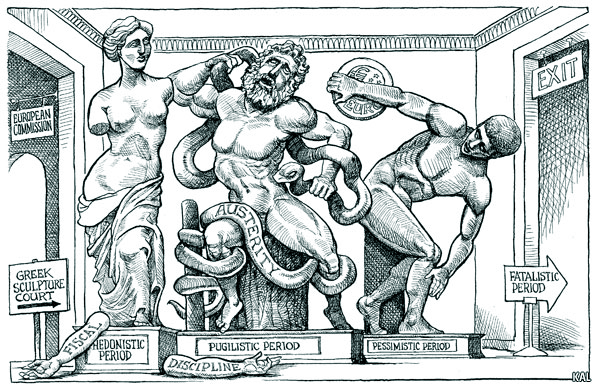 Source: Economist |

Rise in Business Confidence Index after 5 Quarter
The Business Confidence Index in India has moved up and shown signs of improvement after five consecutive quarters in March 2012 according to the latest NCAER (National Council of Applied Economic Research) MasterCard Worldwide Index of Business Confidence. The 80th NCAER MasterCard Worldwide Index of Business Confidence is based on a survey which measures business confidence on four indicators. They include Overall economic conditions six months from now, financial position of firms six months from now, Investment climate and Level of current capacity utilization. All four indicators carry equal weight. The Index is released every quarter. The Business Confidence Index (BCI) increased by 7.7 per cent over the previous quarter to 134.9 points from 125.2 points in January 2012. The rise in the Index indicates an increase in the investor confidence and expectation irrespective of a global slump and high inflation rates. The Index also registered improvement in business environment for the first time since January 2011. The study reflects stability in business sentiments and cautious outlook of the business sector. This change in business sentiments is backed by a number of changes that have taken place on both domestic and global front during the last quarter of FY 2011/12. While moderation in economic growth rates persisted, inflation rate also moderated and the food grain harvest in 2011-12 has been at a record level.
"NCAER MasterCard Worldwide Index of Business Confidence shows some significant changes in the economy during the quarter ending March 2012. After a dip in the year 2011, the index showed positive business sentiments during this time period. In light of the current challenging economic environment, the next quarter index will be worth watching. The study continues to provide great insights on the key factors that affect the business and political environment in India." said Mr. T. V. Seshadri, Division President, South Asia and Country President India, MasterCard Worldwide. It’s encouraging to see how the economy is recovering from the slump. The investors are regaining confidence and there is a positive outlook which has impacted this quarters result notes Dr. Shashanka Bhide, Senior Research Counselor, NCAER. An analysis of the four indicators reveals an improvement in three out of four components of BCI over the previous quarter. Among the three, the largest improvement is in the case of present investment climate. The survey that focuses on trends within firm-specific business outlook indicators also includes a Political Confidence Index (PCI) and a special section on Expectations and Evaluation of Union Budget 201213. The latest survey was conducted in March 2012 and received 528 responses. The data was collected through personal interviews and questionnaires sent to a diverse range of businesses across various regions in India. The Index and its accompanying report do not represent MasterCard financial performance.
Sector wise, analysis of BCI reveals a marked improvement
across all major sectors of the economy except consumer non-durables sector.
Four on five major sectors of the economy reveal improvement in business
sentiments. The consumer non-durables sector shows a decline where BCI
slipped 4.8 per cent from 142.7 in January 2012 to 135.8 now. An improvement
in business sentiments is seen in the present round of survey, the highest
optimism level being registered by firms in intermediate sector where
BCI has jumped up by 14.5 per cent followed by services sector (134.5),
capital goods sector (138.6) and consumer durables sector (135.8) with
7.2 per cent, 6 per cent and 4.2 per cent growth, respectively. Although
business sentiments in consumer non-durables sector show decline, at the
same time it exhibits the second most optimistic BCI among all sectors
after capital goods sector...Read
More
India Inc. Report Card

PM sets up investment tracking cell to boost project implementation
 In
order to address the issue of major investment projects being delayed
for a variety of reasons, the Prime Minister has approved the setting
up of an Investment Tracking System to ensure speedy implementation of
such projects. This issue had come up in the last meeting of the Prime
Minister’s Council on Trade and Industry held in December in which
the Prime Minister had stated that major projects will be specially tracked
to take them forward on a fast track in order to provide a fresh impetus
to the economy. This was in the context of delays faced by projects on
multiple fronts – security clearances, environmental clearances,
other clearances, land related matters, etc. While existing rules and
laws have to be followed, it was widely felt that a lot of the delay is
avoidable if only there is a will to resolve matters.
In
order to address the issue of major investment projects being delayed
for a variety of reasons, the Prime Minister has approved the setting
up of an Investment Tracking System to ensure speedy implementation of
such projects. This issue had come up in the last meeting of the Prime
Minister’s Council on Trade and Industry held in December in which
the Prime Minister had stated that major projects will be specially tracked
to take them forward on a fast track in order to provide a fresh impetus
to the economy. This was in the context of delays faced by projects on
multiple fronts – security clearances, environmental clearances,
other clearances, land related matters, etc. While existing rules and
laws have to be followed, it was widely felt that a lot of the delay is
avoidable if only there is a will to resolve matters.
2. In pursuance of this, an Investment Tracking System has been put in place whereby –
(a) National Manufacturing Competitiveness Council shall track all Public Sector projects with an investment of Rs. 1000 crore and above. The National Manufacturing Competitiveness Council shall submit a quarterly statement of all projects monitored and any issues identified that need resolution, either systemically or individually.
(b) The Department of Financial Services shall monitor projects with an investment of Rs. 1000 crore and above in the private sector. The Department would use data available with the banking sector for this purpose. The Department shall submit a quarterly statement of all projects monitored and issues identified that need resolution, either systemically or individually.
3. Through this mechanism, projects will be periodically reviewed for any delays and specific or systemic issues will be identified for resolution. The Department of Financial Services and the National Manufacturing Competitiveness Council will submit quarterly reports on the tracking being done by them and on identified issues to the Prime Minister’s Office. Corrective action will be taken wherever found necessary.
Govt forms panel to review PSCs...Dr. Rangarajan
PM says will quit public life if charges proved; Team Anna divided
 The
usually sober Prime Minister Manmohan Singh has openly declared that that
he would quit public life if the charges on coal block allotments are
proved. The statements come in reaction to allegations of Team Anna’s
allegations of corruption against him. "It is unfortunate that irresponsible
allegations relating to irregularities in allocation of coal blocks are
being made without confirming facts… I will give up my public life
if allegations are proved against me. My long public career as finance
minister, as leader of the opposition in the Rajya Sabha and now as prime
minister has been an open book," reports said quoting Singh. Media
reports recently stated that the Comptroller Auditor General’s draft
report on the ‘Performance Audit of Coal Block and Allocations’
revealed that 155 coal blocks were allotted to private companies without
auction between 2004 and 2009 which caused the exchequer a loss of Rs.
10.7tn. The controversy has erupted as PM Manmohan Singh, who was in charge
of the Coal Ministry for part of the period mentioned, is being targeted.
Meanwhile, Team Anna seems to be divided on the corruption charges surrounding
the PM. Team member Prashant Bhushan has stuck to his allegations against
the PM and has demanded a special investigation team to probe the charges
against him and 14 other ministers...Read
More
The
usually sober Prime Minister Manmohan Singh has openly declared that that
he would quit public life if the charges on coal block allotments are
proved. The statements come in reaction to allegations of Team Anna’s
allegations of corruption against him. "It is unfortunate that irresponsible
allegations relating to irregularities in allocation of coal blocks are
being made without confirming facts… I will give up my public life
if allegations are proved against me. My long public career as finance
minister, as leader of the opposition in the Rajya Sabha and now as prime
minister has been an open book," reports said quoting Singh. Media
reports recently stated that the Comptroller Auditor General’s draft
report on the ‘Performance Audit of Coal Block and Allocations’
revealed that 155 coal blocks were allotted to private companies without
auction between 2004 and 2009 which caused the exchequer a loss of Rs.
10.7tn. The controversy has erupted as PM Manmohan Singh, who was in charge
of the Coal Ministry for part of the period mentioned, is being targeted.
Meanwhile, Team Anna seems to be divided on the corruption charges surrounding
the PM. Team member Prashant Bhushan has stuck to his allegations against
the PM and has demanded a special investigation team to probe the charges
against him and 14 other ministers...Read
More
Fin Min austerity drive: No new cars, meets at five-stars for govt
Post the country’s dismal Q1 GDP report card in 2012 which reported the slowest growth in nine years, the Finance Ministry, on Thursday, announced a slew of austerity measures to curp spending, reports said. However, analysts are of the opinion that the measures may not be sufficient. According to the circular issued by the Ministry, "For the year 2012-13, every Ministry/Department shall effect a mandatory 10% cut in non-Plan expenditure, excluding interest payment, repayment of debt, Defence capital, salaries, pension and Finance Commission grants to the States." The total non-Plan expenditure for the current fiscal is proposed is Rs.9.69tn. The excluded categories comprise about 72% of India's non-plan expenditure, estimated at Rs.9.7 rupees for the current 2012/13 fiscal year, reports said citing Nitesh Ranjan, an economist at the Union Bank of India. The circular said there was urgent need for rationalisation of expenditure and optimisation of available resources as there was tremendous pressure on Government's resources in the current fiscal situation. There will be total ban on creation of Plan and non-Plan posts. The Government has also banned holding of meetings and conferences in five-star hotels. There will also be 10% cut on the Budgetary allocation for seminars and conferences. Purchase of vehicles will not be allowed until further orders. Also, there will be no purchase against condemned vehicles. The circular also stated that proposals for participation in study tours, workshops, conference, seminars and presentation of papers abroad at Government cost will not be entertained. However, fully-sponsored trips will be exempted. The austerity measures come as the troubled government struggles to curb fiscal deficit, which overshot the FY12 target of 4.8% to stand at 5.95% of GDP.
FM assures IT-Dept will not reopen cases prior to Apr 1, 2012
Soothing the frayed nerves of foreign investors, Finance Minister, Pranab Mukherjee said on Wednesday that the Income-Tax Department will not reopen cases where assessment proceedings had been finalised before April 1, 2012. "I gave a commitment in Parliament with regard to retrospective amendments that CBDT (Central Board of Direct Taxes) will issue a policy circular to clarify that in cases where assessment proceedings have become final before first day of April 2012... Such cases shall not be reopened. Now CBDT has issued a circular in this regard", reports said quoting the FM. Overseas investors were irked by the government’s Union Budget proposal to retrospectively tax mergers and acquisitions of companies where there is an underlying asset located in India and its move to introduce a general anti-avoidance rule to curb sharp tax avoidance practices.
CBDT has issued circular on retrospective amendments: FM
Cabinet clears National Telecom Policy 2012
 The
Union Cabinet approved the National Telecom Policy -2012 (NTP - 2012).
The Cabinet also approved introduction of Unified Licence and authorised
the Department of Telecommunications to finalise the new Unified Licensing
regime with the approval of Minister of Communications & IT. The salient
features of the National Telecom Policy-2012 are as follows:
The
Union Cabinet approved the National Telecom Policy -2012 (NTP - 2012).
The Cabinet also approved introduction of Unified Licence and authorised
the Department of Telecommunications to finalise the new Unified Licensing
regime with the approval of Minister of Communications & IT. The salient
features of the National Telecom Policy-2012 are as follows:
The policy envisions providing secure, reliable, affordable and high quality converged telecommunication services anytime, anywhere for an accelerated inclusive socio-economic development. The main thrust of the Policy is on the multiplier effect and transformational impact of such services on the overall economy. The thrust areas of NTP - 2012 are;
- Increase rural teledensity from the current level of around 39 to 70 by the year 2017 and 100 by the year 2020
- Repositioning of Mobile phone- as an instrument of empowerment
- Broadband –"`Broadband For All" at a minimum download speed of 2 Mbps
- Domestic Manufacturing- Making India a global hub
- Convergence of Network, Services and Devices
- Liberalisation of Spectrum- any Service in any Technology
- Simplification of Licensing regime- Unified Licensing, delinking of Spectrum from License, Online real time submission and processing
- Consumer Focus - Achieve One Nation - Full Mobile Number Portability and work towards One Nation - Free Roaming
- Resale of Services
- Voice over Internet Protocol
- Cloud Computing, Next Generation Network including IPV6
The policy seeks to provide a predictable and stable policy regime for a period of about ten years. Policy will be operationalised by bringing out detailed guidelines, as may be considered appropriate, from time to time. Implementation will enable smooth implementation of the policies for providing an efficient telecommunication infrastructure taking into account the primary objective of maximizing public good by empowering the people of India. The policy will further enable taking suitable facilitatory measures to encourage existing service providers to rapidly migrate to the new regime in a uniformly liberalised environment with a level playing field.
India's April exports up 3.2% at US$24.45bn
 India's
merchandise exports rose by 3.2% to US$24.45bn in April while imports
rose by 3.83% to US$37.94bn, Government data showed on Friday. The figures
are in line with the provisional numbers given by the then Trade Secretary
Rahul Khullar on May 10. In rupee terms, exports were up 20.5% year-on-year
in April this year while imports grew by 21.25% from April last year.
India's trade deficit stood at US$13.48bn in April versus US$13.91bn in
March, the Ministry of Commerce & Industry said. The trade gap in
April was higher than the deficit of US$12.85bn during April 2011. Oil
imports rose by 6.96% year on year to US$13.9bn while non-oil imports
for the month under review up 2.1% at US$24.03bn, the data showed. India's
exports fell by 5.7% in March to US$28.7bn, first fall in four months,
on weakening demand in major exports destinations such as the United States
and Europe. Indian exports rose by 21% to US$303.7bn in the fiscal year
ended in March, while imports rose by 32.2% to US$488.6bn. The trade deficit
for FY12 was US$184.9bn.
India's
merchandise exports rose by 3.2% to US$24.45bn in April while imports
rose by 3.83% to US$37.94bn, Government data showed on Friday. The figures
are in line with the provisional numbers given by the then Trade Secretary
Rahul Khullar on May 10. In rupee terms, exports were up 20.5% year-on-year
in April this year while imports grew by 21.25% from April last year.
India's trade deficit stood at US$13.48bn in April versus US$13.91bn in
March, the Ministry of Commerce & Industry said. The trade gap in
April was higher than the deficit of US$12.85bn during April 2011. Oil
imports rose by 6.96% year on year to US$13.9bn while non-oil imports
for the month under review up 2.1% at US$24.03bn, the data showed. India's
exports fell by 5.7% in March to US$28.7bn, first fall in four months,
on weakening demand in major exports destinations such as the United States
and Europe. Indian exports rose by 21% to US$303.7bn in the fiscal year
ended in March, while imports rose by 32.2% to US$488.6bn. The trade deficit
for FY12 was US$184.9bn.
India: Non-oil import growth likely to decelerate
India's manufacturing PMI holds steady in May: HSBC
 India's
output of the crucial manufacturing sector largely maintained its momentum
in May even as domestic orders slowed, a survey by HSBC showed on Friday.
The purchasing managers’ index (PMI) slipped marginally to 54.8 in
May from 54.9 in April, HSBC Holdings Plc and Markit Economics said in
a statement. It has stayed above the 50 mark, that separates growth from
contraction, for a little over three years now. The survey's output index
rose to 56.4 in May from 56.1 in April, while the employment sub-index
rose to its highest level in ten months. "Activity in the manufacturing
sector kept up the pace in May with output, quantity of purchases and
employment expanding at a faster pace. New orders decelerated slightly,
led by domestic orders," said Leif Eskesen, economist at HSBC. Prices
continued to rise but the pace of price increases moderated slightly from
April. "Inflation is still high by historical standards. In light
of these numbers, the RBI does not have a strong case for further rate
cuts, which if implemented could add to lingering inflation risks,"
added Eskesen.
India's
output of the crucial manufacturing sector largely maintained its momentum
in May even as domestic orders slowed, a survey by HSBC showed on Friday.
The purchasing managers’ index (PMI) slipped marginally to 54.8 in
May from 54.9 in April, HSBC Holdings Plc and Markit Economics said in
a statement. It has stayed above the 50 mark, that separates growth from
contraction, for a little over three years now. The survey's output index
rose to 56.4 in May from 56.1 in April, while the employment sub-index
rose to its highest level in ten months. "Activity in the manufacturing
sector kept up the pace in May with output, quantity of purchases and
employment expanding at a faster pace. New orders decelerated slightly,
led by domestic orders," said Leif Eskesen, economist at HSBC. Prices
continued to rise but the pace of price increases moderated slightly from
April. "Inflation is still high by historical standards. In light
of these numbers, the RBI does not have a strong case for further rate
cuts, which if implemented could add to lingering inflation risks,"
added Eskesen.
The HSBC-Markit PMI survey showed that new export orders continued to grow at a strong pace in May, despite mounting economic and political uncertainties in Europe. The new orders to inventory ratio fell to 1.16 in May from 1.20 in April, which suggests there may be a further fall in the PMI reading next month. In May, the fall was mainly driven by lower domestic demand, with new orders falling to 59.6 from 61.1 in April. "Despite the weak global growth outlook, export new orders remained unchanged at 56.2 in May, likely due to rupee depreciation," say Nomura India economists Sonal Varma and Aman Mohunta. Power and labour shortages remain a bottleneck and as such, the backlog of work index remained elevated, they said in a research note. Meanwhile, the input price index (64.2 in May from 64.8 in April) and the output price index (57.8 from 58.7) eased in May, but remained above their historical averages. There is a growing divergence between the PMI and real activity data. While the March IIP (and Q1 GDP) data suggest that the economic slump has worsened, the PMI data suggests that though momentum gained in Q1 is fading in Q2, activity levels are higher than in H2 2011. "Meanwhile, the USD-INR depreciation is supporting exports, even as it is offsetting the benefits of lower commodity prices and a sub-potential growth," Nomura India says. As such, inflation remains sticky, it adds.
Govt allows QFIs to invest up to US$1bn in corporate debt
The Indian Government has allowed foreign retail investors to directly buy debt in a bid to boost foreign capital inflows and help arrest a relentless slide in the rupee. Accordingly, qualified foreign investors (QFIs) can buy corporate bonds and debt schemes for up to US$1bn, a government statement said on Tuesday. The new US$1bn limit for QFIs is separate from a US$20bn cap on investments by foreign institutional investors (FIIs) in local corporate bonds. The Government has also extended the list of countries whose nationals are allowed to invest in Indian markets, Thomas Mathew, Joint Secretary for Capital Markets in the Union Finance Ministry, told reporters. Mathew also said that he expects it would take about 6 to 18 months for the new capital flows into Indian debt to pick up. The rupee has depreciated about 10% against the US dollar since mid-March after the Government's proposal to curb overseas inflows coming through tax havens such as Mauritius spooked investors. The Government's inability to push through key reforms has also dampened investor sentiment towards India. The rupee, which fell to a lifetime low of 56.40 to the dollar last week, has been the worst performing major Asian currency since February. The Government gave detailed guidelines, allowing QFIs to buy corporate debt. While the proposal had been announced in the Union Budget in March, the Centre had not yet provided details on the proposal, including the investment limit.
Govt approves 25 FDI proposals worth Rs 29.73bn
India's infrastructure sector grows 2.2% in April
 Growth
in India's eight core sector industries decelerated in April 2012, with
Crude Oil, Natural Gas, Petroleum Refinery and Fertilizers delivering
a weak performance over the same month of last year, data released by
the Government showed on Thursday. India's infrastructure sector growth
declined to 2.2% in April 2012 versus 4.2% in the same month a year earlier,
the Government said today. Core sector growth stood at 2.2% in March of
this year. The Index of Eight core industries has a combined weight of
37.90% in the Index of Industrial Production (IIP) with base 2004-05.
The combined Index stood at 142.3 in April 2012 versus 139.2 in April
2011 and 158.7 in March this year. India's infrastructure sector output
expanded by a healthy 7.8% in November 2011 after touching a six-year
low of 0.4% in October 2011. Core sector growth turned back up in December
2011 (4.9%) before sliding again in January 2012 to 0.7%. The growth once
jumped to 6.9% in February before losing steam again in March. During
FY 2011-12, the cumulative growth rate of the core sector industries was
4.4% as against a growth of 6.6% during FY 2010-11. Coal production registered
a growth of 3.8% in April compared to 6.8% in March. Petroleum Refinery
production contracted by 2.8% in April as against a growth of 1.6% in
March. Fertilizer production shrank by 9.3% in April after growing 1.5%
in March. Natural Gas production dropped by 11.3% in April compared to
a decline of 10.1% in March. Crude Oil production declined by 1.3% in
April versus a fall of 2.9% in March. Electricity Generation expanded
by 4.6% in April versus a growth of 2.8% in March. Steel production rose
by 5.8% in April after expanding by 2.3% in March. Cement production grew
by 8.6% in April versus a growth of 7.1% in March.
Growth
in India's eight core sector industries decelerated in April 2012, with
Crude Oil, Natural Gas, Petroleum Refinery and Fertilizers delivering
a weak performance over the same month of last year, data released by
the Government showed on Thursday. India's infrastructure sector growth
declined to 2.2% in April 2012 versus 4.2% in the same month a year earlier,
the Government said today. Core sector growth stood at 2.2% in March of
this year. The Index of Eight core industries has a combined weight of
37.90% in the Index of Industrial Production (IIP) with base 2004-05.
The combined Index stood at 142.3 in April 2012 versus 139.2 in April
2011 and 158.7 in March this year. India's infrastructure sector output
expanded by a healthy 7.8% in November 2011 after touching a six-year
low of 0.4% in October 2011. Core sector growth turned back up in December
2011 (4.9%) before sliding again in January 2012 to 0.7%. The growth once
jumped to 6.9% in February before losing steam again in March. During
FY 2011-12, the cumulative growth rate of the core sector industries was
4.4% as against a growth of 6.6% during FY 2010-11. Coal production registered
a growth of 3.8% in April compared to 6.8% in March. Petroleum Refinery
production contracted by 2.8% in April as against a growth of 1.6% in
March. Fertilizer production shrank by 9.3% in April after growing 1.5%
in March. Natural Gas production dropped by 11.3% in April compared to
a decline of 10.1% in March. Crude Oil production declined by 1.3% in
April versus a fall of 2.9% in March. Electricity Generation expanded
by 4.6% in April versus a growth of 2.8% in March. Steel production rose
by 5.8% in April after expanding by 2.3% in March. Cement production grew
by 8.6% in April versus a growth of 7.1% in March.
India's FY12 fiscal deficit at 5.7% of GDP
India's fiscal deficit during FY12 stood at 5.7% of gross domestic product (GDP) as against the Government's revised estimate of 5.9%, data released by the controller general of accounts (CGA) showed on Thursday. Fiscal deficit was Rs. 5.09 trillion as against the revised estimate of Rs. 5.21 trillion, as per CGA data. Although the Government missed its tax revenue collection targets for FY12, a reduction in plan expenditure and non-plan expenditure helped in controlling its ballooning fiscal deficit. Tax revenues were at Rs. 6.31 trillion, lower than the revised estimate of Rs. 6.42 trillion. Non-plan expenditure and plan expenditure were lower at Rs. 8.84 trillion and Rs. 4.13 trillion respectively. Rising expenditures and lower tax receipts had forced the Government to revise its fiscal deficit target to 5.9% of GDP for FY12, as against the original budget estimate of 4.6% of GDP set in February 2011. The Government is targeting to limit its fiscal deficit to 5.1% of GDP in FY13 by restricting the subsidies to under 2% of GDP. India's revenue deficit during FY12 was at 4.3% of GDP.
CPI for industrial workers shoots up in April vs March
The All India Consumer Price Index (CPI) number for Industrial Workers (CPI-IW) for April 2012 increased by 4 points and stood at 205. The point-to-point rate of inflation based on CPI-IW (General) for the month under review stood at 10.22% compared to 8.65% in March 2012. Inflation based on Food Index stood at 10.66% in April 2012 as against 8.16% in March 2012. The CPI-IW for May 2012 will be released on the last working day of the next month, i.e. 29th June. The maximum increase of 9 points in Amritsar centre was mainly due to increase in the prices of Wheat Atta, Rajmah, Vanaspati Ghee, Fresh Milk, Vegetable & Fruit items, Firewood, Washing Soap, etc. The increase of 8 points each in Jaipur, Madurai and Vadodara centres was due to increase in the prices of Rice, Wheat, Arhar Dal, Groundnut Oil, Milk (Cow), Vegetable & Fruit items, Tea (Readymade), Cigarette, Electricity Charges, Barber Charges, Toilet Soap, Washing Soap, Tailoring Charges, etc. The increase of 7 points each in Mundakkayam, Bhilwara and Faridabad centres was due to increase in the prices of Rice, Groundnut Oil, Vanaspati Ghee, Fish Fresh, Vegetable & Fruit items, Tea (Readymade), Bidi, Firewood, Toilet Soap, Washing Soap, Tailoring Charges, etc. The decrease of 2 points in Belgaum centre was due to decrease in the prices of Rice, Jowar, Chilies (dry), Pan Leaf, etc.
Onset of monsoon may be delayed to mid-next week: IMD
The India Meteorological Department has said that onset of monsoon is likely to be delayed into early or mid-next week, reports said. Monsoon may reach the southern state of Kerala in the next four days, reports said quoting D.S. Pai, head of long-range forecasting division of India Meteorological Department. The monsoon is stalled over Sri Lanka and a delay in onset over Kerala is no cause for concern, he added. The northern limit of monsoon remained stuck across the Colombo latitude for the third day on Friday. The IMD also withdrew the customary outlook on monsoon progress towards Kerala coast. It only said that rains were expected to escalate along the west coast from Jun 5, which is in line with global model forecasts. The circulation has turned winds approaching the Kerala coast to being west-northwesterly, which would not help the onset of rains. The flows would have to be westerly-to-southwesterly to be able to push clouding and moisture into the last mile. The Climate Prediction Centre (CPC) of the US National Weather Services said that the Indian monsoon "appears somewhat delayed this year." Separately, in New Delhi, Agriculture Minister Sharad Pawar said that the monsoon may reach the mainland in Kerala on Jun 7. "According to reports we have received from the weather bureau, monsoon may hit Kerala on June 7." "There’s no cause for concern because of the delay and our aim is to exceed this year’s production in rice next season," he said. The IMD on May 15 had predicted rains to touch Kerala on Jun 1.
RBI pushes for more FII investments in G-secs
 The
Reserve Bank of India (RBI) has placed on its website, the ‘Draft
Report of the Working Group on Enhancing Liquidity in the Government Securities
and Interest Rate Derivatives Markets’ for public comments. Comments
on the draft report may be forwarded, latest by June 22, the RBI said.
It may be recalled that the RBI had announced in the Annual Monetary Policy
Statement that the Draft Report of the Working Group (Chairman: R Gandhi,
ED) would be placed on the Reserve Bank’s website by end-May 2012.
The Reserve Bank of India (RBI) is in favour of relaxing the investment
limit for foreign institutional investors (FIIs) in government securities,
and also doing away with the contentious witholding tax. The RBI released
a draft report by its working group on Thursday, outlining measures to
boost liquidity in government securities and interest rate derivatives
market. "Withholding tax has been cited as a major roadblock for
FII participation in local currency bond markets...elimination of withholding
tax will lead to long-term benefits for the financial market by improving
market efficiency," the RBI draft report said.
The
Reserve Bank of India (RBI) has placed on its website, the ‘Draft
Report of the Working Group on Enhancing Liquidity in the Government Securities
and Interest Rate Derivatives Markets’ for public comments. Comments
on the draft report may be forwarded, latest by June 22, the RBI said.
It may be recalled that the RBI had announced in the Annual Monetary Policy
Statement that the Draft Report of the Working Group (Chairman: R Gandhi,
ED) would be placed on the Reserve Bank’s website by end-May 2012.
The Reserve Bank of India (RBI) is in favour of relaxing the investment
limit for foreign institutional investors (FIIs) in government securities,
and also doing away with the contentious witholding tax. The RBI released
a draft report by its working group on Thursday, outlining measures to
boost liquidity in government securities and interest rate derivatives
market. "Withholding tax has been cited as a major roadblock for
FII participation in local currency bond markets...elimination of withholding
tax will lead to long-term benefits for the financial market by improving
market efficiency," the RBI draft report said.
At present, FIIs can invest up to US$15bn in government bonds. The report suggests issuing multiple benchmarks of various maturities and consolidating the bond market besides favouring reviewing of trading norms for FIIs in the derivatives segment. The RBI draft report also says that FIIs eventually should be allowed to directly take trading positions in the interest rate futures segment based on the overnight cash rates. The working group also favours targeting the mid-level retail investor segment, by way of issuing inflation-indexed bonds, among other measures. In a bid to encourage volumes, the RBI draft report calls for giving out specific securities to primary dealers (PDs) for market making and in turn incentivise the PDs by way of refinance. The report calls for gradual easing of the upper limit on held-to-maturity (HTM) portfolios of banks and emphasises the need for banks to review the HTM at periodic intervals. The working group also suggests that the RBI should allow trading of zero-coupon bonds, known as 'STRIPS' (Separate Trading of Registered Interest and Principal Securities) on the electronic platform. In a bid to widen participation in bonds trading, the working group suggests setting up of an internet-based system access to negotiated dealing system, order matching segment (NDS-OM). For interest rate swaps, the RBI draft report calls for standardising these contracts for a centralised clearing and settlement.
Govt not mulling hike in subsidised fuels: Jaipal Reddy
 The
Government has no immediate plans to hike the retail prices of diesel,
kerosene and cooking gas, Union Petroleum Minister S. Jaipal Reddy said
on Monday. "I am not touching the prices of diesel, LPG or kerosene,"
Reddy told reporters in New Delhi today, adding that no date has yet been
fixed for the EGoM meeting to review the prices of regulated fuels. Reddy
also said that the Petroleum Ministry has recommended raising the excise
duty on diesel vehicles to curb the growing consumption of the fuel. State-run
oil marketing companies have announced a hike in petrol prices by ~Rs
7.54 per litre with effect from May 23 midnight. This was the steepest-ever
increase and came a day after Parliament's budget session ended. The highest
increase prior to this had been by Rs. 5 per litre. This was the first
upward revision in petrol price since November 4, 2011.
The
Government has no immediate plans to hike the retail prices of diesel,
kerosene and cooking gas, Union Petroleum Minister S. Jaipal Reddy said
on Monday. "I am not touching the prices of diesel, LPG or kerosene,"
Reddy told reporters in New Delhi today, adding that no date has yet been
fixed for the EGoM meeting to review the prices of regulated fuels. Reddy
also said that the Petroleum Ministry has recommended raising the excise
duty on diesel vehicles to curb the growing consumption of the fuel. State-run
oil marketing companies have announced a hike in petrol prices by ~Rs
7.54 per litre with effect from May 23 midnight. This was the steepest-ever
increase and came a day after Parliament's budget session ended. The highest
increase prior to this had been by Rs. 5 per litre. This was the first
upward revision in petrol price since November 4, 2011.
However, media reports suggested last week that political pressure both, from UPA partners and opposition parties, may force the Government to rollback some of the steep increase in petrol prices.A meeting of the Inter Ministerial Group on inflation was called by Finance Minister, Pranab Mukherjee today, to discuss the impact of petrol price hike on inflation. The Chief Economic Adviser, Dr. Kaushik Basu, was also present at the inter-ministerial grouping on inflation. The EGoM on fuel prices, headed by Mukherjee, hasn’t met since June 2011 even though depreciation in the rupee and rise in crude oil prices have raised the cost of imports. A meeting of the Inter Ministerial Group on inflation was called by Finance Minister, Pranab Mukherjee today, to discuss the impact of petrol price hike on inflation. The Chief Economic Adviser, Dr. Kaushik Basu, was also present at the inter-ministerial grouping on inflation. The EGoM on fuel prices, headed by Mukherjee, hasn’t met since June 2011 even though depreciation in the rupee and rise in crude oil prices have raised the cost of imports.
Rationalisation of petroleum price, tax necessary: CII
Bombay HC issues notices to govt, OMCs on petrol price hike
CBI commences investigation of coal block allocation charges
The Central Bureau of Investigation has begun an investigation in the alleged scam in the allocation of coal blocks to private companies during the period 2006-09, reports said. Media reports recently stated that the Comptroller Auditor General’s draft report on the ‘Performance Audit of Coal Block and Allocations’ revealed that 155 coal blocks were allotted to private companies without auction between 2004 and 2009 which caused the exchequer a loss of Rs.10.7tn. Interestingly PM Manmohan Singh, was in charge of the Coal Ministry for part of the period mentioned. The CBI took the step after the Central Vigilance Commission (CVC) forwarded a complaint to it filed by BJP leader and Rajya Sabha MP Prakash Javadekar in March to start a probe. Reports said that it is alleged that coal was allotted to companies which were "ineligible", and were in some cases fronts for other companies. Recently, Team Anna too made serious allegations again Singh on charges of corruption in allocating the blocks. Reacting to the allegations the PM said: "It is unfortunate that irresponsible allegations relating to irregularities in allocation of coal blocks are being made without confirming facts… I will give up my public life if allegations are proved against me. My long public career as finance minister, as leader of the opposition in the Rajya Sabha and now as prime minister has been an open book." A statement from the PMO stated that coal fields were allocated with complete transparency, and that bids were invited through ads placed in newspapers.
Govt clarifies reports on coal block allotment during 2004-09
Doubts have been raised in certain quarters regarding allocation of coal blocks to private companies for captive use during the period 2004-2009. As per media reports letters have also been written purportedly to the Government raising similar issues. Clarifications in regard to these issues had already been placed on the website of the Ministry of Coal on 17th May, 2012. However, certain issues are reiterated and further clarified as below:
Allocation of coal blocks to private companies for captive use commenced in the year 1993 after the Coal Mines (Nationalisation) Act, 1973 was amended. This was done with the objective of attracting private investments in specified end uses. Initially there was not much demand for such allocation and the applicants themselves used to identify the coal blocks and seek allocation. As the economy grew in size, the demand for coal also grew, particularly due to expansion in the energy sector. It was felt that Coal India Ltd. alone would not be able to meet the growing demand and, therefore, the option of giving a bigger role to the private sector was explored. It is in this background that we should appreciate the reasons for allocation of coal blocks to private parties for captive use during this period.
While allocation of coal blocks began in 1993, it was only in 2004 that for the first time, the idea of making allocations through competitive bidding was mooted and in 2005 the government initiated a proposal to amend the Coal Mines (Nationalization) Act. The delay of three years between initiating the process of legislative changes and introducing the amendment Bill in the Parliament was mainly due to time taken in consensus building among divergent views of the various stakeholders. State governments such as Chhattisgarh, West Bengal and Rajasthan were opposed to the amendment as they felt that it would increase the cost of coal, adversely impact value addition and development of industries in their areas and would dilute their prerogative in selection of an allocatee...Read More
PM discusses recommendations on allocation of natural resources
Coal Ministry says no need for arbitration with TCI
Following a meeting with The Children’s Investment Fund, the Coal Ministry on Tuesday said there was no need for any arbitration with the hedge fund on violation of Bilateral Investment Protection Agreement (BIPA) in Coal India. "Issues can be sorted out amicably. We have discussed with them the issues and also asked them further presentations if they have any issue," reports said quoting Coal Secretary Alok Perti. The Coal Ministry had said earlier that it would meet TCI, the minority shareholder in Coal India, this week. The fund had threatened legal action against CIL on various counts. TCI is the second largest shareholder in Coal India after the government and has investments in CIL through TCI Cyprus Holding Ltd and Talos Capital Ltd, which is registered in Ireland. TCI has been irked with the government and says its "recent conduct with respect to CIL has seriously impaired business activities and operations of CIL," reports said earlier. Earlier reports stated that TCI was against the move of the Government to make Coal India sign fuel supply agreements (FSAs) with private power producers to supply coal to them at subsidized rates and guaranteeing to supply 80% of contracted quantity. The fund is angry about the reversal in prices Coal India adopted ‘blindly’ following the Government’s directive, which was a breach of its fiduciary duties towards shareholders. The hedge fund had also requested for formal negotiations with Indian government on the issue for amicable settlement of the claims under the respective treaties.
EGoM to meet on Jun 5 on 2G spectrum pricing
Led by Finance Minister Pranab Mukherjee, an Empowered Group of Ministers (EGoM) will meet on Jun 5 to take a call on the controversial base price for the auction of 2G airwaves, reports said. Earlier this year the Supreme Court cancelled 122 licences issued under scam tainted ex-telecom minister A Raja, over irregularities in their allotment and allocation in 2008. A state auditor said the sale could have cost as much as $34 billion in lost revenue to the exchequer. The court had then directed the Telecom Regulatory Authority of India to make fresh recommendations for grant of licence and allocation of 2G spectrum. However, the TRAI during the release of its recommendations in April proposed to hike the starting price of the new auction by ten times, to Rs. 181.11bn from Rs. 16.59bn, operators paid in 2008. These proposals did not go down well with the telecom industry and operators and lobbies urged the government not to accept the recommendations. The Telecom Commission (TC), last week, left the decision on the high-powered ministerial panel of fixing the price of spectrum to be auctioned. It also instructed TRAI to conduct an analysis of the impact of spectrum price on tariff if it was passed on, and in case it was absorbed, what would be the likely effect on companies' businesses, viability and return on investment. The detailed analysis, along with the regulator’s recommendations, would be presented to the EGoM for its decision.
Banks to restructure Rs.350 loans for textile sector
Providing a sigh of relief to the textile sector, the government has allowed restructuring of Rs. 350bn worth of loans. Following a meeting with Finance Minister Pranab Mukherjee, Textiles Minister Anand Sharma said, "The RBI (Reserve Bank of India) will now be discussing the restructuring of loans." Sharma said that the total debt of the sector had risen to Rs.1.5tn, of which Rs. 35,000 crore needed immediate restructuring and the government would soon direct the banks to do the same. It was also decided that the restructuring package would be on a case-to-case basis and would be taken up by each bank separately. The Finance Ministry and the RBI will also consider a 2-year moratorium on term loans, norms on non-performing assets and conversion of depleting working capital into working capital term loans repayable over 3-5 years. Industry experts have cheered the move. "This was much needed and will help the industry to continue giving employment to over 11 million workers and also to meet export target of $17 billion set for the year 2012-13," reports said quoting A Sakthivel, chairman, Apparel Export Promotion Council. The textile sector has been riddled with the global slowdown, a sharp decline in cotton yarn prices, currency volatility and rise in transport costs and wages. Besides, textile units have been unable to repay their loans and arrange for working capital due to the increase in bank interest rates. The textiles and clothing industry is the second most important economic activity in the country in terms of employment generation (after agriculture). It is also one of the major sources of export earnings for the country and livelihood of millions is dependent on this sector, according to a report of the National Council of Applied Economic Research (NCAER), an economic think tank.
There is need to support textile industry: Govt
Govt notifies guidelines for short-term power procurement by Discoms
The Government has notified guidelines for short-term (i.e. for a period of less than or equal to one year) procurement of electricity by Distribution Licensees under section 63 of the Electricity Act, 2003. The new guidelines will promote competitive procurement of short-term power requirement by the Distribution Licensees and are also expected to reduce the overall cost of procurement of power leading to significant benefits for consumers. The specific objectives of these Guidelines are as follows:
- Promote competitive procurement of electricity by Distribution Licensees for their short term demand (less than or equal to one year);
- Reduce the Power Purchase Bill of Discoms through a process of planned procurement based on transparent guidelines;
- Provide benefit to consumers;
- Facilitate transparency and fairness in procurement processes.
A few exceptions have also been made under the new guidelines which have been finalised after consultation with all stakeholders. Procurement of Power for less than 15 days shall be excluded from the scope of these Guidelines to allow for contingencies. Power procured under Banking Mechanism and from Power Exchanges shall also be excluded from the scope of these Guidelines. The need for guidelines for short term procurement of electricity was felt as Distribution Companies (DISCOMs) engage in purchase or sale of electricity in the short-term market to meet their demand for electricity for shorter duration not exceeding one year. Power purchase cost constitutes the largest cost component for Distribution Licensees reflecting in the retail consumer tariff. Since short-term procurement of electricity was being done by the DISCOMs in large scale to meet the urgent short term requirement it was decided to issue the guidelines for short term procurement of power by Distribution Licensees through competitive bidding process...Read More
EGoM clears Mahan, Chhatrasal coal blocks
An Empowered Group of Ministers (GoM), headed by Finance Minister Pranab Mukherjee, said that the Mahan coal block and the Chhatrasal block should be given forest clearance, subject to certain conditions. The Mahan block has been allocated to Hindalco and Essar group while the Chhatrasal block is attached to Reliance Power's Sasan UMPP. The EGoM yesterday recommended an in-principle approval for mining the Mahan coal block. The commissioning of this coal block would take at least 18 months. The Mahan coal block was jointly allocated to Essar Power and Hindalco in 2006. Hindalco has spent more than US$3bn on the associated expansion projects. "The company’s stock price has corrected ~50% from its peak largely on project delays and concerns that Mahan may not receive forest clearance. This approval should alleviate investor concerns," IIFL says in a research note to its clients. Mahan coal block was earmarked for Essar Power and Hindalco in April 2006. Reliance Power was to source coal from Chhatrasal for its 4,000 MW ultra-mega power project at Sasan.
The GoM decision, with some caveats, still needs the Union cabinet’s approval. Together, these two coal blocks will fire up a power capacity of over 10,000 MW, according to reports. The Union Environment Ministry’s reservations about allotting the coal blocks to power and aluminum projects have been rejected after an expert panel reviewed their impact on environment and communities, reports said. The EGoM has also put on hold the proposal of Union Coal Minister, Sriprakash Jaiswal to allocate alternative coal blocks for captive use by power, steel and ceramics companies. The EGoM has, however, issued ~15 conditions. The companies will have to shell out 5% of their project cost towards corporate social responsibility (CSR) activities, reports said. In addition, they will have to mitigate their action through parallel means if they destroy any forest area and effect the wildlife and must undertake compulsory afforestation of land area equal to that destroyed by the mining activity. The Mahan coal block, located in Singrauli fields in Madhya Pradesh, is estimated to have a reserve potential of 150mn tons of thermal coal and will feed the upcoming power plants of Essar Power and Hindalco Industries.
The coal block is currently held by Mahan Coal, a joint venture company equally held by Essar Power and Hindalco Industries. While Essar Power has an off-take agreement of 60%, or 5.4mn tons per annum (mtpa), of coal from the block to feed its upcoming 1,200 MW power plant in the state, Hindalco Industries will take the remaining to fuel its 750 MW power plant. Hindalco has an off-take agreement of 3.6 mtpa of coal from Mahan coal block. Hindalco’s power plant will, in turn, supply captive power to its upcoming 359 kilo tons per annum aluminium smelter - Mahan Aluminium - which is likely to be commissioned in the current fiscal year. Coal from Chhatrasal will be extensively used for Reliance Power's 4,000 MW Sasan ultra mega power project and the 4,000 MW Chitrangi power project.
Tata Motors May sales up 4% YoY
 Tata
Motors’ total sales (including exports) of Tata commercial and passenger
vehicles in May 2012 were 64,347 vehicles, higher by 4%, over May 2011.
The company’s domestic sales of Tata commercial and passenger vehicles
for May 2012 were 60,128 nos., higher by 6%, over 56,571 nos., sold in
May last year. Cumulative sales (including exports) for the company for
the fiscal are 124,433 nos., lower by 2%, over 126,353 nos., sold last
year.
Tata
Motors’ total sales (including exports) of Tata commercial and passenger
vehicles in May 2012 were 64,347 vehicles, higher by 4%, over May 2011.
The company’s domestic sales of Tata commercial and passenger vehicles
for May 2012 were 60,128 nos., higher by 6%, over 56,571 nos., sold in
May last year. Cumulative sales (including exports) for the company for
the fiscal are 124,433 nos., lower by 2%, over 126,353 nos., sold last
year.
Commercial Vehicles
The company’s sales of commercial vehicles in May 2012 in the domestic market were 39,625 nos., a 7% growth, compared to 37,170 vehicles, sold in May last year. LCV sales were 27,174 nos., a growth of 26%, compared to 21,638 vehicles sold in May, last year. M&HCV sales stood at 12,451 nos., lower by 20%, compared to 15,532 vehicles sold in May, last year. Cumulative sales of commercial vehicles in the domestic market for the fiscal are 74,272 nos., a growth of 1% over last year. Cumulative LCV sales are 51,992 nos., a growth of 17% over last year, while M&HCV sales stood at 22,280 nos., lower by 24%, over last year...Read More
Cyrus Mistry inducted to Tata Motors Board
Tata Motors skids on lower-than-forecast margins
Mahindra Auto sales rise 28% in May
Mahindra & Mahindra Ltd. (M&M Ltd.), India’s leading SUV manufacturer, today announced a 28% rise in its auto sales numbers, which stood at 43988 units during May 2012 as against 34323 units during May 2011. The company’s domestic sales stood at 39938 units during May 2012, as against 32159 units during May 2011, an increase of 24%. The Passenger Vehicles segment (which includes the UVs and Verito) has registered a growth of 27%, having sold 21154 units in May 2012, as against 16702 units during May 2011. Speaking on the performance, Pravin Shah, Chief Executive, Automotive Division, Mahindra & Mahindra Ltd. said, "We are happy to have achieved a growth of 28% during May 2012 in spite of difficult and uncertain market conditions. All our brands, especially those in the personal category are doing well. With the planned ramp up of production capacity and the re-opening of bookings of the XUV500 effective 8th of June pan India, we expect to meet the demand of many more of our XUV500 customers"...Read More
Mahindra Tractor sales flat in May
Maruti Suzuki May sales down 5% YoY
 Maruti
Suzuki India has reported total sales of 98,884 units in May, down 5%
from the same month a year earlier. Domestic sales stood at 89,478 units,
down 4.3% from last year. Exports stood at 9,406 units, down 10.9% YoY.
Total sales of passenger vehicles are down 5.9% at 72,309 units. Barring
Compact, Super Compact and Utility Vehicles, all the other segments have
reported a sharp drop in sales during the month under review compared
to the year-ago period. In thedomestic market the fall was led by 29%
yoy fall in the Mini segment and 39.3%yoy fall in the Vans category. "Both
these segments having predominantly petrolvariants, increasing differential
between cost per km for a petrol and dieselcar has caused the dent in
the demand," according to India Infoline Research. However, Compact,
Super Compact and UVssegment, which have diesel variants, saw a strong
growth of 14.7%, 63.8% and 603%respectively. The successful launch of
Ertiga drove the performance for the UV segment, India Infoline Research
said. Exportsales were at 9,406 units, lowest in seven months. Overseas
sales were down 10.9% yoy onthe back of worsening of the Euro debt crisis.
Maruti
Suzuki India has reported total sales of 98,884 units in May, down 5%
from the same month a year earlier. Domestic sales stood at 89,478 units,
down 4.3% from last year. Exports stood at 9,406 units, down 10.9% YoY.
Total sales of passenger vehicles are down 5.9% at 72,309 units. Barring
Compact, Super Compact and Utility Vehicles, all the other segments have
reported a sharp drop in sales during the month under review compared
to the year-ago period. In thedomestic market the fall was led by 29%
yoy fall in the Mini segment and 39.3%yoy fall in the Vans category. "Both
these segments having predominantly petrolvariants, increasing differential
between cost per km for a petrol and dieselcar has caused the dent in
the demand," according to India Infoline Research. However, Compact,
Super Compact and UVssegment, which have diesel variants, saw a strong
growth of 14.7%, 63.8% and 603%respectively. The successful launch of
Ertiga drove the performance for the UV segment, India Infoline Research
said. Exportsales were at 9,406 units, lowest in seven months. Overseas
sales were down 10.9% yoy onthe back of worsening of the Euro debt crisis.
Hero MotoCorp May sales up 11.3% YoY
Hero MotoCorp Ltd. (HMCL), the world’s largest two-wheeler manufacturer, today reported its best-ever monthly sales, thus underlining the robust momentum the company has sustained since embarking on its solo journey. Marking its 10th consecutive month of over five lakh sales, Hero MotoCorp despatched 5,56,644 two-wheelers in May, a growth of 11.3% over the corresponding month last year when the company had sold 5,00,234 units. The company’s sales in May this year surpassed its previous highest of 5,51,557, recorded only last month (April’12). Anil Dua, Senior Vice-President (Marketing and Sales), Hero MotoCorp Ltd. said, "We have been setting new industry benchmarks month after month which is an indication not only of our progress in our journey but also the trust of our valued customers. The first two consecutive months of the new fiscal recording highest-ever sales for the company has clearly been a great start for us. Notwithstanding the slowdown in the overall economy and the prevailing sentiment in the country, we are cautiously optimistic that the expected normal monsoon and the consequent good harvest should perk up the mood in the coming months.
TVS Motor May sales fall ~5% yoy
 TVS
Motor has reported total sales volume of 1.76 lakh units in May 2012 vs
1.85 lakh units sold in the same month last year. This translates into
a decline of close to 5%. Total two-wheeler sales in May stood at 1.73
lakh units vs 1.81 lakh units sold in May 2011. TVS Motors registered
a year-on-year fall of 4.1% in its total domestic volumes in May 2012
at 153,195 units. Export volumes' fell last month by 12.8% yoy at 22,817
units. Mopeds' volume grew 3% yoy at 70,125 units during May 2012 while
that of scooters was up 1.7% yoy at 38,833 units. Motorcycle sales fell
15.2% yoy during the month at 64,134 units. Three-wheeler volumes were
lower by 27.7% on yoy basis at 2,920 units.
TVS
Motor has reported total sales volume of 1.76 lakh units in May 2012 vs
1.85 lakh units sold in the same month last year. This translates into
a decline of close to 5%. Total two-wheeler sales in May stood at 1.73
lakh units vs 1.81 lakh units sold in May 2011. TVS Motors registered
a year-on-year fall of 4.1% in its total domestic volumes in May 2012
at 153,195 units. Export volumes' fell last month by 12.8% yoy at 22,817
units. Mopeds' volume grew 3% yoy at 70,125 units during May 2012 while
that of scooters was up 1.7% yoy at 38,833 units. Motorcycle sales fell
15.2% yoy during the month at 64,134 units. Three-wheeler volumes were
lower by 27.7% on yoy basis at 2,920 units.
CRISIL to acquire Coalition, UK-based analytics firm
CRISIL announced that it has entered into an agreement to buy 100% of the equity shares of UK-headquartered Coalition Development Ltd. along with its subsidiaries. Coalition provides high-end analytics, mainly to leading global investment banks. Formed in 2002, Coalition is a dynamic high-growth company firmly established as a premium brand. Coalition reported 2011 revenues of GBP 8 million. The all-cash transaction has a maximum payout of GBP 29 million (around Rs.2.5bn) with earn outs over 2 years, linked to achievement of specified milestones for the company's future revenues and profits. The acquisition will add to the earnings per share of CRISIL from the first year. The transaction is subject to regulatory approvals. Coalition deploys unique proprietary analytics and algorithms to provide deep analytics on market size and dynamics, revenue opportunities and human capital. Coalition's analytics provide a clear, actionable picture of the markets and are used by boards, strategy teams and top management at leading financial services institutions.
Indian Oil's full-year results soft but better than expected: Moody's
Moody's Investors Service says that Indian Oil Corporation's (IOC, Baa3 stable) results for FYE March 2012 were softer than the previous year due to a decline in gross refining margins to $3.63 per barrel from $5.72. The decline in margins was in line with the cyclical downturn in the refining industry, and the results -- which were announced on May 28 -- could have been worse, if the Indian government had not decided on May 21 to reimburse IOC in full for its fuel subsidy burden. In FYE2012, the company incurred subsidy-related losses of Rs755 billion (USD13.6 billion), of which the government will reimburse Rs455 billion and upstream oil and gas companies the remaining Rs300 bn. The announced full reimbursement has helped maintain IOC's consolidated EBITDA margin at 5.6% against 5.8% last year. If IOC had had to absorb the subsidy, its EBITDA would have fallen significantly. Although neither the government, nor the upstream oil and gas companies have yet made the reimbursements, the results for FYE2012 have incorporated the anticipated payments on an accrual basis. "In the absence of the payments, IOC's consolidated credit metrics for FYE2012 weakened with EBITDA/ Interest declining to 3.9x from 6.0x a year ago, debt/ EBITDA increasing to 3.3x from 3.1x, and debt/capital rising to 54% from 48%," says Vikas Halan, a Moody's Vice President and Senior Analyst.
Bharti's Ratings unaffected by Qualcomm's deal: Fitch
Fitch Ratings says that Bharti Airtel Limited's (Bharti) Long-Term Foreign-Currency Issuer Default Rating of 'BBB-' with Negative Outlook is unaffected by its acquisition of US-based chip maker Qualcomm's broadband wireless access (BWA) spectrum assets in India. "Although Bharti's rating has limited headroom for a large debt-funded acquisition, the acquisition of a 49% stake in Qualcomm's Indian entity does not immediately burden its balance sheet," says Nitin Soni, Associate Director, Fitch's Asia-Pacific Telecom, Media and Technology team. "Only when Bharti increase its ownership of Qualcomm's BWA Indian entities to 100% by end-2014 will it then have full responsibility to service the entities' outstanding debt." The Negative Outlook continues to reflect the adverse effect of India's uncertain regulatory environment. Fitch is monitoring regulatory decisions that may result in higher regulatory cash outflows than the agency's base case assumptions. The agency notes that a large regulatory cash outflow coupled with a much earlier-than-expected (prior to FY15) responsibility to service the additional debt at Qualcomm's BWA entities could result in a negative rating action, particularly if Fitch expects Bharti's funds from operations-adjusted net leverage to remain above 2.5x on a sustained basis (financial year ended-March 2012: 2.7x). Bharti announced on 24 May 2012 that it acquired a 49% stake in Qualcomm Asia Pacific's Indian BWA entities for an upfront cash consideration of USD165m (INR9.1bn). Of this USD75m will firstly be used to acquire a 26% equity interest in Qualcomm's BWA entity that is currently equally held by Global Holding Corporation Private Limited - parent company of GTL Infrastructure Limited (Fitch 'C(ind))' - and Tulip Telecom Limited (Tulip, 'Fitch A+(ind)'/Negative). The balance subscription of USD90m will be used to acquire fresh equity in these entities. This will give Bharti a right to use Qualcomm's spectrum assets in Delhi, Mumbai, Haryana and Kerala...Read More
Pantaloon to be unaffected by format business demerger: Fitch
Fitch Ratings says that the proposed demerger of the Pantaloon format business (Pantaloon Retail and Pantaloon Factory outlets) is not expected to impact the credit profile of Pantaloon Retail India Limited (PRIL, 'Fitch A-(ind)'/Stable) and Future Value Retail Limited (FVRL, 'Fitch A-(ind)/Stable). Aditya Birla Nuvo Limited (ABNL) has proposed to acquire a controlling interest in the new entity post demerger. Fitch expects that post demerger lower inventory requirements and a shift towards lower discretionary retail format accruing to PRIL will be counterbalanced by a decline in its operating profitability, resulting in no immediate credit impact. Fitch expects PRIL's (excluding the Pantaloon format business) overall fixed charge ratio (operating EBITDAR/net interest expense + rents) to remain in the range of 1.1x to 1.3x, a level consistent with the present ratings. The current positive rating guidelines include an improvement in PRIL's operating parameters (such as inventory turns and operating margins) leading to lower adjusted leverage levels of around 5x and higher fixed charge of above 1.5x on a sustained basis. Negative rating guidelines include a weakening in same-store-sales growth (SSSG), resulting in lower EBITDA margins or higher-than-expected debt-led capex/investment in its core business/subsidiaries, leading to adjusted leverage exceeding 7.0x on a sustained basis.
ABNL will subscribe to PRIL's Rs. 8bn optionally fully convertible debentures (OFCDs), and subsequently the Pantaloon format business will be demerged to a separate entity. The OFCDs along with PRIL's additional debt of INR8bn is likely to be transferred to the new entity. Fitch expects the infusion of INR8bn from ABNL (which will be initially in the form of debt and would be converted into equity in the new entity) to provide a liquidity cushion and be used largely to refinance existing debt. Post demerger, PRIL on a standalone basis will continue to own formats such as Central, e-Zone, Home Town and other lifestyle formats. Fitch will continue to analyse the residual portion of PRIL's retail business on a consolidated basis, including FVRL and other retail related subsidiaries and excluding Future Capital Holdings Ltd. On the basis of 9MFY12 (nine months ended March) results, an estimated 14% of PRIL's (pre-transaction) revenue and 19% of EBITDA will move to the new company. PRIL's post-transaction revenue would be driven by FVRL which is likely to contribute 70% to the overall sales mix.
Keshub Mahindra to retire as Chairman of M&M
Keshub Mahindra, Chairman of Mahindra & Mahindra Ltd., advised the Board of his intention to retire from the Board at the conclusion of the forthcoming Annual General Body Meeting scheduled on August 8, 2012. The Board reluctantly acceded to the Chairman’s desire but requested him to accept the position of Chairman Emeritus, emphasizing that the Company required his advice and counsel. Keshub Mahindra joined the Board of the Company in 1948 and was elected Chairman in 1963. During the 48 years of his Chairmanship, the Mahindra Group grew from a manufacturer of automobiles to a federation of companies operating in a range of businesses which includes automobiles, tractors, auto components, I.T., real estate, financial services and hospitality. Over the years he successfully created business alliances with global majors such as the Willys Corporation, Mitsubishi, International Harvester, United Technologies, British Telecom and many others, laying the foundation for the emergence of the Group as an Indian multi-national. In addition, he built a team of leaders who were not only recognized as outstanding professionals but were also dedicated to the highest standards of business ethics and corporate governance. The Board expressed its deep gratitude to Keshub Mahindra for the outstanding services rendered by him not only to the Mahindra Group, but also to industry and to the nation, over a period that spanned the early post-independence era, the Licence Raj and the two decades of liberalization and globalization. During this entire period the Group never deviated from its core values and code of ethics. Even before the buzz word of Corporate Social Responsibility came into vogue in the corporate world, the Mahindra Group quietly and unobtrusively developed a high sense of service to the community on a wide range of social issues with special emphasis on education for the girl child and youth from the underprivileged sections of society...Read More
Israel Makov appointed Chairman of Sun Pharma Board
Sun Pharmaceutical Industries Ltd has announced that the Board of Directors of the Company at its meeting held on May 29, 2012, has appointed Israel Makov. a resident of Israel, as an additional Director on the Board of Directors of the Company. Further the Company has informed that, Dilip Shanghvi has stepped down from the Chairmanship of the Company while continuing to remain the Managing Director of the Company and Israel Makov has been appointed as the Chairman of the Company at meeting of the Board of Directors of the Company held on May 29, 2012. Speaking on the induction, Dilip Shanghvi, Managing Director of Sun Pharma said "I welcome Makov on behalf of the entire Board and the larger Sun Pharma team. He is an exceptional leader with deep knowledge and experience in globalizing businesses successfully. As Sun Pharma continues to rapidly expand its presence worldwide, I am sure that we will benefit immensely from his experience." On his appointment, Makov said, "I am happy to accept the position of Chairman of the Board. Sun Pharma is an exciting company poised for substantial global expansion and I look forward to working together with Dilip and his team in realizing their visionary goals."
GVK receives environmental approval for Alpha Coal project
GVK, one of India’s major diversified infrastructure companies, has received the Queensland Coordinator General’s Report on the environmental clearance for the Alpha Coal and Rail Project in Queensland. The milestone is a major achievement for GVK and its Alpha Project is now the only Galilee Basin proponent with an approved Environmental Impact Statement (EIS). After having agreed general terms in December 2010, GVK invested in three mines (Alpha, Alpha West and Kevin’s Corner) with total resources of 8bn tonnes of thermal coal in addition to the rail and port facilities. The Alpha Coal Project consists of a 30 million tonnes per annum (mtpa) mine, a 495km standard gauge railway with 60mtpa approvals and a terminal and two berths at Abbot Point catering for at least 60mtpa of thermal coal destined for Asian markets. Dr. GVK Reddy, Chairman and Managing Director, GVK said, "I am tremendously proud of the hard work our team at GVK has put into achieving this milestone which now paves the way for us to complete financing and secure final mining approvals for the Alpha Project in the second half of 2012. I would like to acknowledge the Queensland government for their efforts in making this happen within a few months of their winning the elections. We remain committed to developing our world class projects in a timely and responsible manner and ultimately bring widespread benefits to this great state." The Coordinator General’s report is a major step in finalising the regulatory requirements and enables us to fast track the completion of key construction and operations contracts...Read More
Essar Ports announces strategic alliance with Port of Antwerp International
Essar Ports Limited ("Essar Ports"), one of the largest private sector port companies of India, announced the creation of a long-term strategic alliance with Port of Antwerp International ("PAI") and an investment of approx. Rs. 1.75bn by PAI in Essar Ports. PAI is the international investing arm of the Antwerp Port Authority, which is the port authority of the port of Antwerp, the 2nd largest port in Europe handling 187 MMT of cargo in 2011, and a gateway to many European economies. The Antwerp Port Authority and Essar Ports will collaborate in the areas of training and consultancy services, port planning, traffic flow, quality and productivity improvement and will further build a mutually beneficial commercial relationship based on mutual business and investment preferences. Both Essar Ports and PAI will mutually assist in the growth in the volume of their businesses. On this occasion, Marc Van Peel, president of the Antwerp Port Authority: "Essar Ports is a highly regarded, strong and reliable partner with a lot of know-how in India. We will rely on them for the development of port activities in India, one of the strategic regions of our daughter company PAI. The port of Antwerp will share her knowledge and expertise on port development and strategy with Essar Ports.This added value for both parties will create breeding grounds for further development of both regions."
As a part of the Strategic Alliance Agreement signed between the two parties on 30th May 2012, PAI has invested approx. Rs. 1.75bn in Global Depository Shares ("GDS") of Essar. Ports at a price of Rs. 100 per share equity share underlying the GDS. These GDS would form approximately 4% of the diluted equity share capital of Essar Ports. PAI’s investment in Essar Ports is long-term and strategic in nature, focusing on the commercial relationship between the two companies and mutually enhancing the productivity, skill set and performance. PAI will also have the right to nominate a director on the Board of Essar Ports and Mr. Jan Adam, CFO- Port of Antwerp has been appointed as Non-Executive Director in the Board of Essar Ports Ltd...Read More
Gujarat NRE Coke's Aussie arm inducts Jindal Steel as strategic partner
Gujarat NRE Coking Coal Limited, (GNM or the Company) is pleased to announce that it has entered into an Option Off Take agreement with Jindal Steel & Power Limited (Jindal) and would also make a placement of new shares in favour of Jindal Steel & Power (Mauritius) Ltd. The shares would be issued by the Company under the 15 % placement limit available under Listing Rule 7.1. The placement is expected to be completed by 30th May 2012. Speaking on the development,Arun Kumar Jagatrarnka, Executive Chairman of the Company said "We are extremely pleased to introduce Jindal Steel and Power Limited as a long term strategic partner and investor in the Company. This is a win-win deal for both parties, since it provides secured supply of Premium Hard Coking Coal to Jindal Steel while it diversifies the customer base of the Company."
RPower led consortium to set up LNG terminal in AP
Reliance Power and Kakinada Seaports along with Royal Dutch Shell will jointly set up a liquefied natural gas (LNG) terminal on the east coast to meet the country's gas demand, according to reports. Reports stated that the consortium will set up the LNG terminal in Andhra Pradesh and hopes to complete the project in 2014. The terminal will have an initial capacity of up to 5 million tonnes per annum,reports said. While Shell operates a 3.6 mt a year capacity LNG terminal at Hazira in Gujarat, the project off the Andhra coast "is expected to start with a capacity of up to 5 mt per annum, reports said. There are reports that Shell and billionaire Anil Ambani-run RPL will hold the majority of the equity in the terminal company.
Delhi HC quashes PNGRB tariff order...IGL shares soar
Shares of Indraprastha Gas, Gujarat Gas, Gujarat State Petronet (GSPL), Petronet LNG and Gail India jumped after the Delhi High Court struck down an order of sector regulator PNGRB's tariff order. The Delhi High Court said that the PNGRB does not have the power to fix network tariff or the power to decide any component of the retail price. IGL had approached the Delhi High Court over the constitutionality and legality of the powers of the PNGRB to fix network tariffs. In April, PNGRB had ordered IGL to cut network tariff by a whopping 60% retrospectively from April 2008. The total refund on account of the retrospective nature of the order was pegged between Rs. 9-12bn. IGL had argued that the order would wipe out the company's entire net worth of Rs. 15bn. IGL is the sole distributor of CNG (compressed natural gas) and PNG (piped natural gas) in New Delhi and adjoining NCR areas.
Mahindra XUV 5OO to open All India bookings from 8th June 2012
Mahindra & Mahindra Ltd has announced that it will open bookings for its cheetah-inspired XUV500 from 8th June, 2012. With this announcement, the XUV500 will now be available across India including the existing 19 cities where it had been launched earlier. In the second phase of bookings, the XUV500 was made available in 19 cities across India and had received an overwhelming 25000+ booking applications from customers. Out of these booking requests, the names of 7200 winning applicants were selected through an automated process, called the XUV500 Draw. While announcing the nation-wide opening of bookings for the XUV500, Pravin Shah, Chief Executive, Automotive Division, Mahindra & Mahindra Ltd. said, ‘It has been an incredible journey so far for the XUV500 and we are pleased to take the product national. We have been inundated with requests for re-opening of bookings not just from existing cities but also from cities where the XUV500 was not available. Now that we have ramped-up our production capacity significantly, we are confident that we will be able to take care of the growing all-India demand for the XUV500." The Mahindra XUV500 comes with cheetah-inspired styling, refinement like never before and enhanced technology and safety features along with luxurious interiors, making the XUV500 an apt choice for sedan and SUV buyers.
MCA refers Reebok India fraud case to SFIO
"Something wrong" has been found in the books of Reebok India, said Corporate Affairs Minister Veerappa Moily. He added that the Ministry of Corporate Affairs has referred the matter to the Serious Fraud Investigation Office (SFIO) following a non-invasive scrutiny of the books of accounts of the company. Sportswear company Reebok had recently accused its former Managing Director Subhinder Singh Prem and former Chief Operating Officer Vishnu Bhagat of a Rs. 87bn scam, reports said. Reebok alleges that the duo had 'stolen' products by setting up 'secret warehouses', fudged accounts and indulged in fictitious sales. Singh, who was the MD of Adidas India 2011 onwards, following Adidas’s takeover of Reebok in 2005, was sacked when the scam came to the fore in March 2012. Bhagat was also dismissed from the company. Meanwhile, earlier this month, Prem had sued Adidas for Rs. 150mn. Adidas had then said that it would close some of its Reebok outlets in India as it was restructuring operations after discovering "irregularities" at Reebok India. Prem has stated that although the company’s cites ‘commercial irregularities’ in India operations, it was entirely aware of how the company was being run. Also, he said that the finance and accounts were approved by up to five layers of officials. Singh had also denied being involved in any financial irregularity and claimed to have uncovered scams at the company.
Akzo Nobel India announces buyback offer at Rs 920/share
Akzo Nobel India Ltd. announces the buyback of up to 1,300,000 fully paid-up Equity Shares of Rs. 10 each from the existing shareholders / beneficial owners of Equity Shares of the Company, on a proportionate basis, through the tender offer process, in accordance with the provisions of the Companies Act and SEBI regulations. The share buyback is subject to approval/s as may be necessary, from time to time from statutory authorities, including but not limited to SEBI, Stock Exchanges, RBI, etc. The buyback has been declared at a price of Rs. 920 per share payable in cash, for an aggregate maximum amount of Rs. 1,196mn. The buyback size represents 8.7% of the aggregate of the Company's paid-up equity share capital and free reserves as on March 31, 2012, which stands at Rs. 13,758mn. The maximum amount required by the Company for the said buyback, totaling to Rs. 1,196mn will be met out of the free reserves and / or cash balances and / or internal accruals of the Company. The maximum amount utilized for the buyback will not exceed 10% of the paid up equity share capital and free reserves of the Company as on March 31, 2012. The Company proposes to buy back a maximum of 1,300,000 fully paid-up equity shares of Rs. 10 each, in the proposed tender buyback offer. The buyback price of Rs. 920 per share has been arrived at after considering the present stock market conditions, trends in the market price of equity shares of the Company, book value as on March 31, 2012 and the possible impact on the EPS and financial ratios and other relevant considerations. ICICI Securities Ltd. is the Lead Manager to the buyback.
Ramky Infra falls on Jagan Reddy's arrest
Shares of Ramky Infrastructure declined following the arrest of the son of late YSR Reddy, Y.S. Jagan Mohan Reddy, who is an MP and the president of YSR party. The infrastructure company had been in the news recently over the alleged links of the company’s Chairman, Ayodhya Rami Reddy, for obtaining benefits in the Ramky Pharma City during YSR Reddy’s tenure. Rami Reddy has also been listed by the Central Bureau of Investigation as one of the co-accused in the disproportionate assets case of Y.S. Jagan Mohan Reddy. Only on Monday, reports stated that the CBI court in Hyderabad had remanded YSR Congress chief Jagan Mohan Reddy, to 14-day judicial custody till June 11 in connection with the disproportionate assets case. Senior CBI counsel Ashok Bhan alleged that Reddy "sent (bribe amount) abroad and got it reinvested in his business through hawala racket". "Jagan got enriched enormously in a short span of four years after influencing his father Rajashekhar Reddy, the then chief minister of Andhra Pradesh in getting ill gotten money into his own firms from investors who doled out favours as part of quid pro quo," the counsel alleged.
Speciality Restaurants shares inch higher in listless debut
Speciality Restaurants Ltd. had a good debut in a weak market, with its shares hitting day's high after a marginally positive opening. The stock closed the week at Rs 167.00 after touching a peak of Rs 175.90 and a low of Rs 152. The IPO of Speciality Restaurants was subscribed 2.49 times. The total bids received stood at 2,48,88,920 shares as against the issue size of 99,78,503 shares. The IPO had opened on May 16 and closed on May 18. The price band had been fixed between Rs. 146 and Rs. 155 per share. The issue constituted 25% of the post-issue paid-up equity share capital of the Company. The Book Running Lead Manager to the Issue were Kotak Mahindra Capital Company Limited. The company will use the IPO proceeds for development of new restaurants, food plaza and for repayment of term loan.

Euro at two-year low on Spanish woes; Spanish bond yields slip
The euro fell to a two-year low versus the US dollar as Spanish borrowing costs rose amid the nation's struggle to rescue its troubled banks, fueling concern that Europe’s debt crisis is spreading from the periphery to the core. The euro slid below US$1.24, reflecting continued concerns about the debt-stricken region. Spanish bonds came under renewed pressure in the wake of news that Egan Jones Ratings Co. has downgraded the country's debt to B from BB-, with a negative outlook. However, three major rating firms - S&P, Moody's and Fitch - still rate Spanish debt as investment grade. The yield on Spain's 10-year government bond rose to 6.5% while that of Italy surpassed 6%, according to reports. Spain’s 10-year bond yields are approaching the 7% mark that heralded bailouts in Greece, Ireland and Portugal. Spain was additionally pressured by news that the Bank of Spain Governor Miguel Angel Fernández Ordóñez will step down early. In addition, media reports said that the European Central Bank (ECB) has reportedly shot down the Spanish government's plan to recapitalize troubled lender Bankia SA with government debt.
The euro was poised for the biggest monthly decline since September. The euro lost 5.9% in May, headed for its largest monthly drop since September. The dollar posted its biggest monthly gain since 2011 in May, beating bonds, stocks and commodities for the first time this year, as investors sought refuge in US assets while Europe’s sovereign crisis worsened. The euro fell against the yen to the weakest level in more than 11 years while the Dollar Index climbed to a 21-month high.
Spanish stocks slid amid concerns about the country’s banks and as fresh data showed the extent of the nation’s economic problems. Retail sales for April dropped for a 22nd consecutive month, tumbling 9.8% on an annual calendar-adjusted basis, as consumers curtailed spending. Troubled lender Bankia SA shares sank after Exane BNP Paribas SA became the latest to cut the stock’s price target, slashing it 68% following a recapitalization of the bank. Several brokers cut their ratings on the stock.
The problem in Spain is that the Spanish government cannot afford to recapitalize local banks and so far the ECB has not intervened. Separately, governing council member of the European Central Bank (ECB) Ewald Nowotny said there were no talks of reinstating government bond purchases or providing more long-term loans to banks. When asked about Spain’s banking problems, he said rescuing those institutions was the responsibility of national governments. Nowotny also said that the aim was to keep Greece in the eurozone, but that the decision was up to the country and its government.
Eurozone unemployment stays at record high 11% in April
The unemployment rate in the eurozone held steady at an all-time high of 11% in April, while the total number of unemployed in the region increased by 110,000 to a euro-era record of 17.405mn, the European Union statistics agency, Eurostat reported. Economists had forecast an unemployment rate of 11%. The unemployment rate in the broader 27-nation European Union (EU) rose to 10.3% in April, as employers slashed 102,000 jobs. That was the highest EU unemployment rate on records that go back to 2000. The highest unemployment rates was recorded in Spain at 24.3%, while the lowest rate was in Austria at 3.9%. Greek unemployment hit 21.7% in February, the most recent month for which figures are available. There were 24.7mn unemployed in the EU in April, of whom 17.4mn were in the eurozone. The unemployment rate for March for the 17 nations that use the euro was also raised to 11% in Friday's jobs report from the initial reading of 10.9%, while the March reading for the EU was 10.2%.
US economy adds 69k jobs; Unemployment rate up
The US economy added less-than-expected jobs in May while the unemployment rate unexpectedly increased as job-seekers re-entered the American workforce, raising concern about the sluggish economic recovery in the world's largest economy. American employers added just 69,000 new jobs in May, the smallest increase in a year, the government reported on Friday. Economists had forecast an increase of 165,000 new non-farm payrolls. The unemployment rate, meanwhile, rose to 8.2% from 8.1%, mainly because more people entered the labor force even as hiring slowed. The jobless rate was expected to hold steady. Employment gains for April and March were revised lower. The number of new jobs created in April was reduced to 77,000 from an original estimate of 115,000, while March's figure was trimmed to 143,000 from 154,000.
Eurozone manufacturing PMI hits 3-year low in May
Manufacturing sector activity across the debt-stricken eurozone contracted at the fastest pace in three years in May, according to the Markit survey. The Markit purchasing managers' index for the sector fell to 45.1 last month from 45.9 in April and was little changed from a preliminary estimate of 45.0. A reading of less than 50 signals a contraction in activity. "Eurozone manufacturers reported a deepening downturn in May, indicating that the damage to the real economy caused by the region's financial and political crises continues to spread across the region," said Chris Williamson, chief economist at Markit. The data indicates that the manufacturing sector is contracting at a quarterly pace of around 1%, Markit said. The eurozone manufacturing PMI has signaled contraction in each of the past 10 months. Manufacturing production dropped at the steepest rate since June 2009 while marked reduction was also observed in new order inflows. Among the euro area members, Ireland was the only nation to signal an expansion in manufacturing activity in May. The Austrian PMI slipped closer to stagnation. Manufacturing activity in Germany, France and Spain fell to their lowest levels since mid-2009. The downturn in the Netherlands accelerated to its fastest in five months. Rates of contraction eased slightly in Italy and Greece, but remained steeper than the euro average. Czech manufacturing performed the worst in 33 months in May, as new orders declined at the fastest pace in almost three years.
Unrated European LBOs remain under pressure: Moody's
Brazil cuts benchmark rate by 50 bps
Brazil's central bank cut its benchmark overnight rate to the lowest level on record, as it continues to try and shore up sluggish domestic growth amid deteriorating economic prospects elsewhere in the world. As expected, the central bank cut the Selic rate by 0.5% to 8.5% per year, a smaller cut than the three-quarter-point reductions seen at the last two meetings of the monetary policy committee, or Copom. The Brazilian central bank appeared to indicate that it may cut rates further. Risks to inflation remain limited and the global economic fragility has been disinflationary, the central bank said in a statement. The decision to cut rates was unanimous. This was the Brazilian central bank's seventh consecutive rate cut. The Brazilian economy has failed to take off after a meager expansion of 2.7% in 2011. With industry in recession, economists now see growth this year falling below 3%.
China's manufacturing sector loses more steam in May
China's official purchasing managers’ index (PMI) showed that manufacturing grew less than estimated last month, stoking speculation that policymakers will unveil more stimulus to counter a deceleration in the world’s second-biggest economy. China’s manufacturing PMI was 50.4 in May, the National Bureau of Statistics and China Federation of Logistics & Purchasing said today. The reading compares with the 52.0 median estimate of economists. The official data came in below expectations. Economists had expected a reading of 51.5. A print below 50 implies contraction while a reading above 50 indicates expansion. CFLP said that while the data showed a slowdown, the index has remained above the 50-point threshold for six months, indicating that growth momentum has not changed. It also added that the drop in PMI doesn’t mean that the Chinese economy has entered a new phase of recession. Meanwhile, the HSBC survey showed that China's factory activity contracted for a seventh straight month in May. The final reading of the HSBC manufacturing PMI fell to 48.4 in May on a 100-point scale, compared to a April's 49.3, and weaker than an initial "flash" reading of 48.7. Among sub-components of the HSBC PMI, measures of new orders and output both fell below the 50-level, which separates expansion from contraction.
Brent oil falls below US$100/bbl on global growth concerns
Brent oil fell below US$100 a barrel on Friday for the first time since October 2011, as weak manufacturing data from China to Europe fueled concerns about future demand prospects from key regions of the world. Brent crude traded as low as US$99.60, the lowest since October 4. Brent for July settlement fell to US$99.61 a barrel on the ICE Futures Europe exchange in London. That was the lowest since Oct. 4, when it tumbled to US$99.11. The contract is down 7% this year. Saudi Arabia's Oil Minister Ali al-Naimi said on May 13 in Adelaide, Australia, that he wanted to see Brent drop to US$100 a barrel. Oil output by the Organization of Petroleum Exporting Countries (OPEC) increased in May to the most since 2008, as Saudi Arabia pumped at the fastest pace in at least 23 years, according to reports. OPEC production increased 20,000 barrels to an average 31.595mn barrels a day in May from a revised 31.575mn in April, according to reports. The euro extended declines against the dollar and yen after a report showed that unemployment in the euro currency area reached the highest on record and the region's manufacturing activity slumped to a three-year low.
The jobless rate in the euro region was at 11% in April and March, the European Union’s statistics office in Luxembourg said today. That was the highest since the data series started in 1995. Separately, data today showed that manufacturing sector activity across the debt-stricken eurozone contracted at the fastest pace in three years in May. The Markit purchasing managers' index (PMI) for the sector fell to 45.1 last month from 45.9 in April and was little changed from a preliminary estimate of 45.0. A reading of less than 50 signals a contraction in activity. China's official PMI showed that manufacturing grew less than estimated last month, stoking speculation that policymakers will unveil more stimulus to counter a deceleration in the world’s second-biggest economy. China’s manufacturing PMI was 50.4 in May, the National Bureau of Statistics and China Federation of Logistics & Purchasing said today. The reading compares with the 52.0 median estimate of economists. The official Chinese data came in below expectations. Economists had expected a reading of 51.5. India's output of the crucial manufacturing sector largely maintained its momentum in May even as domestic orders slowed, a survey by HSBC showed today. The PMI slipped marginally to 54.8 in May from 54.9 in April, HSBC Holdings Plc and Markit Economics said in a statement.
UK's manufacturing PMI sinks to three-year low in May
Manufacturing activity in the UK plummeted at the fastest rate since the height of the 2008-09 global financial crisis last month, as stringent budget cuts continued to crimp the British economy even as euro area debt crisis deepened. Data from Markit showed that headline Purchasing Managers’ Index (PMI) in the UK fell to 45.9 in May compared to a revised down reading of 50.2 in April. Economists had forecast a reading of 49.9. A reading of less than 50 indicates activity shrank. It was the fastest rate of decline in three years. This was the second-fastest rate of contraction in the UK's manufacturing activity since the PMI figures were first issued 20 years ago. Markit described the May PMI figure as a sudden sharp turn for the worse. The decline came as companies scaled back production and employment as inflows of new business declined at the steepest pace since March 2009, it said. Rob Dobson, senior economist at Markit and author of the PMI report, said that the fall was not simply linked to the eurozone’s debt crisis, but also to the increasing weakness of the UK domestic market. He added that, barring a sharp turnaround in June, manufacturing output in the UK could fall by as much as 1% in the second quarter. The sector could become a major drag on the UK economy and extend the recession into the middle of the year.
Japan’s unemployment rate rises; Retail sales drop
Japan’s unemployment rate surprisingly increased last month while retail sales declined for a second straight month, underscoring concern that recovery in the world's third-largest economy will lose steam in the face of a stronger yen and Europe’s debt crisis. Japan’s jobless rate rose to 4.6% in April from 4.5% in March, the first increase in three months, the statistics bureau said today in Tokyo. The median estimate of economists was 4.5%. Japan’s jobless totaled 3.15mn in April, down 140,000 from last year, while those with jobs totaled 62.75mn, down 270,000 from the year-ago period. The Japanese Ministry of Internal Affairs and Communications said that the weaker employment data was driven by workers more willing to give up their jobs in search of high paying opportunities or better positions. Japanese retail sales rose 5.8% in April compared to a year ago, data released today showed. Economists had been expecting a 6.3% rise in retail sales. Retail sales in April fell 0.3% from March, the Trade Ministry reported today. In March, Japan's retail sales were up 10.3%. The Internal Affairs ministry also reported that average monthly consumption expenditure per household rose 3.2% to 301,948 yen in nominal terms and increased 2.6% in real terms compared to the year-ago period.
Passenger traffic strong; Cargo demand improves: IATA
The International Air Transport Association (IATA) announced global traffic results for April showing that total passenger demand rose 6.1% while freight demand was 4.2% down on April 2011. Despite continuing economic weakness in some parts of the world, demand for air travel continues to grow. The 6.1% overall growth recorded for April is above the 20-year trend. Strong demand for air travel with limited capacity expansion pushed load factors to 79.3% which is a record high for an April load factor. The 4.2% contraction in air freight markets compared to April 2011 is somewhat misleading. Air freight markets slumped sharply in the first half of 2011 and bottomed out towards the end of the year. Various distortions and month-to-month volatility have marked the industry performance since the beginning of 2012. However, April cargo levels stood at about 2% higher than in November 2011. About 80% of this improvement has been captured by Middle Eastern airlines. Air freight for the Asia-Pacific, European and North American carriers has continued to show weakness...Read More
RIM may post an operating loss in Q1: CEO
Research In Motion Limited (RIM) , a world leader in the mobile communications market, today provided a business update from Thorsten Heins, the Company’s President and CEO. "During the Q4 2012 and fiscal year-end financial results conference call on March 29, I said that I would provide our shareholders with candid and timely updates when possible on the progress and challenges RIM is experiencing. While we are no longer giving quantitative financial guidance, I wanted to provide a brief business update at this time, and will provide more details when our Q1 financial results for the quarter ended June 2, 2012 are released on June 28. In terms of challenges, as I mentioned on the March financial results conference call, RIM is going through a significant transformation as we move towards the BlackBerry 10 launch, and our financial performance will continue to be challenging for the next few quarters. The on-going competitive environment is impacting our business in the form of lower volumes and highly competitive pricing dynamics in the marketplace, and we expect our Q1 results to reflect this, and likely result in an operating loss for the quarter. We are continuing to be aggressive as we compete for our customers’ business – both enterprise and consumer – around the world, and our teams are working hard to provide cost-competitive, feature-rich solutions to our global customer base. On the positive side, we expect to further increase our cash position in Q1 from the approximately $2.1 billion we had at the end of fiscal 2012...Read More
Formula One defers Singapore IPO on weak markets
Formula One Group is delaying its initial public offering worth up to US$3bn in Singapore citing weak market conditions, with the sport's head and part-owner, Bernie Ecclestone, saying that the firm was waiting for the right time to tap the markets. Ecclestone was quoted as saying that it would be wrong to talk of any delay because no firm date had been set for an IPO: "It is going to be this year, we said we would do it this year," he was quoted as saying. Formula One has dropped plans to lodge its IPO prospectus with Singapore authorities next week, according to reports, as private-equity firm CVC Capital Partners is not in a hurry to launch its offering and will continue to test investor appetite before making a firm offering. CVC Capital Partners, the major shareholder in Formula One, unveiled a US$1.6bn deal last month to sell a 21% stake in the business to US investments groups Waddell & Reed and BlackRock, along with Norway's Norges Bank Investment Management. The sale cut CVC's stake to around 42%.
Bankers were in the process of launching pre-marketing for Formula One's IPO and were planning to launch the preliminary prospectus with the Monetary Authority Of Singapore by June 5, reports suggested. Goldman Sachs, Morgan Stanley and UBS have been hired to lead the Formula One IPO. It is the fifth major IPO to be pulled or delayed in Asia over the past week alone as global markets have tumbled on concerns over the long-running eurozone credit crisis and slowdown in the Chinese economy. Investors are also wary of new IPOs following the disastrous debut of social network giant Facebook. The stock price of Facebook has fallen 22% in 10 trading sessions since its debut in the United States. On Thursday, UK-based jeweler Graff Diamond Corp. pulled its US$1bn IPO in Hong Kong, citing weak market conditions. Australia's Cape Lambert Resources Ltd. said Thursday it has delayed a planned IPO of its Marampa iron ore project due to volatility in capital markets. Globally, the amount raised from stock market offerings is down 46% this year from the same period of last year. Excluding Facebook, 72 US-listed firms have filed, raising US$13.1bn, which is down 53%, according to data provider Thomson Reuters.
Marubeni to acquire Gavilon for US$3.6bn
Marubeni Corp. said Tuesday it has agreed to acquire the US's third-biggest grain handler Gavilon Group LLC for US$3.6bn, a deal that will make the Japanese trading company one of the world's largest grain traders. The deal, which is expected to be completed by September, will double Marubeni's grain trading capacity. Marubeni’s 25 million metric tons of grains trading capacity will rise to 55 million tons with the Gavilon deal and also add oil & gas trading volumes, the Japanese company said. This is the largest cross-border acquisition by a Japanese company so far this year, according to Dealogic. Marubeni, Japan’s biggest agricultural trading company, gained 2.6% to 517 yen in Tokyo. The Nikkei 225 benchmark index rose 0.7%. Marubeni has spent ~US$11bn in overseas purchases since the beginning of last year, according to Dealogic. Companies like Mitsui & Co., Glencore International Plc, Bunge Ltd. and Wilmar International Ltd. had also shown interest in Omaha, Nebraska-based Gavilon, according to reports. Gavilon was formed when the trading arm of ConAgra Foods Inc. was sold for US$2.8bn in 2008 to an investor group led by Ospraie Special Opportunities Fund, General Atlantic LLC, and a fund managed by Soros Fund Management LLC.
CGI to acquire Logica for C$2.8bn
Prudential Plc to acquire SRLC America for US$621mn

|
June, 2012 |
|||||||
|
COMPANY NAME |
S3 |
S2 |
S1 |
CLOSING PRICE |
R1 |
R2 |
R3 |
| ABB | 633 |
656 |
693 |
716 |
752 |
776 |
812 |
| ACC | 1,052 |
1,072 |
1,106 |
1,127 |
1,161 |
1,181 |
1,215 |
| Ambuja Cem | 132 |
138 |
143 |
149 |
154 |
160 |
166 |
| BHEL | 187 |
192 |
202 |
207 |
217 |
222 |
231 |
| BPCL | 614 |
638 |
671 |
695 |
728 |
751 |
785 |
| Bharti | 288 |
292 |
297 |
301 |
306 |
310 |
315 |
| Cairn | 281 |
291 |
308 |
317 |
334 |
343 |
360 |
| Cipla | 291 |
296 |
303 |
309 |
315 |
321 |
327 |
| DLF | 163 |
169 |
177 |
183 |
190 |
196 |
203 |
| Gail | 285 |
300 |
315 |
330 |
345 |
360 |
375 |
| Grasim | 1,985 |
2,052 |
2,179 |
2,246 |
2,373 |
2,440 |
2,567 |
| HCL Tech | 443 |
456 |
474 |
487 |
506 |
519 |
537 |
| HDFC Bank | 461 |
468 |
483 |
490 |
505 |
512 |
527 |
| Hero Honda | 1,740 |
1,763 |
1,798 |
1,821 |
1,856 |
1,879 |
1,914 |
| Hindalco | 104 |
108 |
112 |
117 |
121 |
125 |
129 |
| HUL | 391 |
400 |
411 |
420 |
431 |
439 |
450 |
| HDFC | 609 |
618 |
635 |
643 |
660 |
668 |
685 |
| ICICI Bank | 694 |
717 |
759 |
782 |
824 |
847 |
889 |
| Idea | 65 |
68 |
73 |
76 |
80 |
84 |
88 |
| Infosys | 2,128 |
2,200 |
2,317 |
2,389 |
2,507 |
2,579 |
2,696 |
| ITC | 220 |
225 |
229 |
234 |
237 |
242 |
246 |
| L&T | 1,016 |
1,047 |
1,104 |
1,135 |
1,192 |
1,223 |
1,280 |
| M&M | 611 |
621 |
635 |
645 |
659 |
669 |
683 |
| Maruti | 958 |
989 |
1,045 |
1,075 |
1,131 |
1,161 |
1,217 |
| Nalco | 44 |
49 |
52 |
58 |
61 |
66 |
69 |
| NTPC | 136 |
139 |
142 |
145 |
148 |
151 |
154 |
| ONGC | 224 |
230 |
241 |
246 |
257 |
262 |
273 |
| Powergrid | 96 |
98 |
102 |
104 |
107 |
109 |
112 |
| PNB | 667 |
684 |
711 |
727 |
754 |
771 |
797 |
| Ranbaxy | 422 |
440 |
474 |
493 |
527 |
545 |
579 |
| Rcom | 54 |
56 |
61 |
63 |
67 |
69 |
73 |
| Reliance | 615 |
634 |
666 |
685 |
717 |
736 |
768 |
| Reliance Infra | 360 |
378 |
412 |
430 |
464 |
482 |
516 |
| Reiance Power | 80 |
83 |
87 |
89 |
93 |
96 |
100 |
| Satyam | 61 |
64 |
70 |
74 |
80 |
83 |
89 |
| Siemens | 560 |
582 |
622 |
644 |
685 |
707 |
747 |
| SBI | 1,847 |
1,895 |
1,980 |
2,028 |
2,113 |
2,161 |
2,246 |
| SAIL | 83 |
85 |
89 |
91 |
95 |
98 |
102 |
| Sterlite | 79 |
82 |
88 |
91 |
97 |
100 |
106 |
| Sunpharma | 539 |
548 |
560 |
569 |
580 |
590 |
601 |
| Suzlon | 12 |
14 |
16 |
18 |
20 |
22 |
24 |
| Tata Com. | 199 |
204 |
211 |
217 |
223 |
229 |
236 |
| TCS | 1,165 |
1,183 |
1,207 |
1,225 |
1,249 |
1,267 |
1,291 |
| Tata Motors | 143 |
164 |
204 |
225 |
264 |
285 |
325 |
| Tata Power | 83 |
87 |
90 |
93 |
96 |
99 |
102 |
| Tata Steel | 365 |
374 |
389 |
398 |
413 |
422 |
437 |
| Unitech | 18 |
19 |
20 |
21 |
23 |
24 |
25 |
| Wipro | 371 |
380 |
392 |
402 |
413 |
423 |
435 |
| Zee | 113 |
116 |
123 |
126 |
132 |
136 |
142 |
|
NOTE : S1, S2 and S3 are critical support levels while R1, R2 and R3 are resistance levels. Trading call depends on the price band |
|||||||
For subscription/
adding names to weekly newsletter mailing list,
Click
here
Website : http://www.indiainfoline.com
IIFL
Centre, 2nd Floor,
Kamala City, Senapati Bapat Marg,
Lower Parel (W), Mumbai - 400 013
E-mail: editor@indiainfoline.com
India's
most popular website for business and investing.
© Copyright 2012, India Infoline Ltd
India Infoline takes no legal responsibility for accuracy or completeness
of information or advice given.
This material is for personal use only.


5 Weekly positional calls
Three positive months and two really bad ones – that is the score card for the Indian equity markets so far this year. June has started on an ominous note, with stock indices slumping on the back of disappointing economic reports – both domestic as well as overseas. Three events will largely determine markets’ direction this month. They are: Greek elections on June 17, the RBI’s mid quarter review and progress of monsoon.
Any unfavorable outcome from these two events can potentially do more damage to the already battered investor confidence. Voters in Greece and the RBI both are stuck between the rock and a hard place. Making a choice is not going to be easy for either of them.
In the meantime, investors will continue to take cue from economic reports. From India’s point of view, the rupee’s weakness continues to be a big headache. Improvement in capital flows and fall in current account gap can lift the rupee. Positive policy prescriptions can also go a long way in addressing the governance deficit.
The India Infoline Weekly Wrap keeps you abreast of the markets and arms you for the markets in the coming week. To access the India Infoline Weekly Wrap, just Click Here
Buy Hindalco
Buy HDFC Bank
Buy GAIL
Buy Jet Airways
Buy HUL

| Major Indices |
01-June-12 |
25-May-12 |
% Change |
| BSE Sensex | 15,965 |
16,218 |
-1.6 |
| NSE Nifty | 4,842 |
4,920 |
-1.6 |
| Dow Jones* | 12,393 |
12,455 |
-0.5 |
| Nasdaq * | 2,827 |
2,838 |
-0.4 |
| Hang Seng | 18,630 |
18,713 |
-0.4 |
| Nikkei | 9,380 |
8,580 |
9.3 |
| Shanghai Comp | 2,262 |
2,334 |
-3.1 |
| Bovespa (Brazil)* | 54,490 |
54,463 |
0.1 |
|
* Close as on last Thursday |
|||

| Major Indices |
01-June-12 |
25-May-12 |
% Change |
| Rupee to Dollar | 51.2 |
55.4 |
-7.5 |
| Rupee to Euro | 67.7 |
73.2 |
-7.5 |

|
Major Indices |
01-June-12 |
25-May-12 |
% Change |
| Gold std. (Rs/10gm) | 29,016.0 |
28,840 |
0.6 |
| Silver (Rs/kg) | 52,800.0 |
53,538 |
-1.4 |
| Crude Oil ($ per barrel) | 84.4 |
106.9 |
-21.1 |


RN
Nayak, CMD, Power Grid Corporation of India
 Anil
Mascarenhas of IIFL gives you the key highlights of a media interaction
post the results where RN Nayak says, "POWERGRID has planned Rs.
1000bn capital expenditure in XII Plan including Rs. 200bn in FY13."...More
Anil
Mascarenhas of IIFL gives you the key highlights of a media interaction
post the results where RN Nayak says, "POWERGRID has planned Rs.
1000bn capital expenditure in XII Plan including Rs. 200bn in FY13."...More
Mr.
G. Chokkalingam, Executive Director & CIO, Centrum Wealth
 In
an exclusive interview with Hemant P. Maradia of IIFL, Mr. G. Chokkalingam
says, "We firmly believe that the chances of Nifty going below 4,800
on fundamental factors are less."...More
In
an exclusive interview with Hemant P. Maradia of IIFL, Mr. G. Chokkalingam
says, "We firmly believe that the chances of Nifty going below 4,800
on fundamental factors are less."...More
Mr.
Kadambi Narahari, CEO, SBI Cards
 Dolly
Mirchandani of IIFL gives you the highlights of a media interaction where
Kadambi Narahari says, "We plan to add 1 million cards by 2014-15."...More
Dolly
Mirchandani of IIFL gives you the highlights of a media interaction where
Kadambi Narahari says, "We plan to add 1 million cards by 2014-15."...More
Mr.
A. Ramasubramanian, President, Asia Motor Works Limited
 In
an exclusive interview with Hemant P. Maradia of IIFL, Mr. A Ramasubramanian
says, "Margins will continue to be under pressure this year with
cost increases not fully recovered through market prices."...More
In
an exclusive interview with Hemant P. Maradia of IIFL, Mr. A Ramasubramanian
says, "Margins will continue to be under pressure this year with
cost increases not fully recovered through market prices."...More
Steve
A. Ballmer, Chief Executive Officer, Microsoft Corporation
 Yash
Ved of IIFL brings you a few key points of the opening keynote by Steve
Ballmer, at Microsoft India Technology Summit (via video link), where
he says, "The launch of Windows 8 is a rebirth of the company."...More
Yash
Ved of IIFL brings you a few key points of the opening keynote by Steve
Ballmer, at Microsoft India Technology Summit (via video link), where
he says, "The launch of Windows 8 is a rebirth of the company."...More
G
Subramaniam, Chief Financial Officer, Hathway Cable and Datacom Limited
 Replying
to Anil Mascarenhas of IIFL, G Subramaniam says, "Television remains
an important part of the social development of the country and cable therefore
will have an opportunity to play a role in this growth."...More
Replying
to Anil Mascarenhas of IIFL, G Subramaniam says, "Television remains
an important part of the social development of the country and cable therefore
will have an opportunity to play a role in this growth."...More
Dr.
Mukesh Batra, CMD, Dr. Batra's Positive Health Clinic
 Speaking
with Yash Ved of IIFL, Dr. Mukesh Batra says, "We have grown at a
CAGR of 22% in the last three years and we are planning to grow at 30%
in FY13."...More
Speaking
with Yash Ved of IIFL, Dr. Mukesh Batra says, "We have grown at a
CAGR of 22% in the last three years and we are planning to grow at 30%
in FY13."...More
Mr.
Susheel Koul, Director, Enaltec Labs
 Replying
to Anil Mascarenhas of IIFL, Susheel Koul says, "For the regulated
markets, 15 products have been developed so far out of which 9 are on
a pre-commercialized stage."...More
Replying
to Anil Mascarenhas of IIFL, Susheel Koul says, "For the regulated
markets, 15 products have been developed so far out of which 9 are on
a pre-commercialized stage."...More
Maitreya
Doshi, Promoter and Chairman & Managing Director, Premier Ltd.
 In
an exclusive interview with Hemant P. Maradia of IIFL, Mr. Doshi says,
"We expect pilot supplies of FIAT diesel engines to start in June
and see rise in volumes."...More
In
an exclusive interview with Hemant P. Maradia of IIFL, Mr. Doshi says,
"We expect pilot supplies of FIAT diesel engines to start in June
and see rise in volumes."...More
André
Corniere, Director, Steel, Tekla Corporation
 Replying
to Yash Ved of IIFL, André Corniere says "While our global turnover
is 60 million Euros, 25% of the revenue is re-invested in R&D."...More
Replying
to Yash Ved of IIFL, André Corniere says "While our global turnover
is 60 million Euros, 25% of the revenue is re-invested in R&D."...More
Achal
Bakeri, CMD, Symphony Ltd
 In
an exclusive interaction with Anil Mascarenhas and Dolly Mirchandani of
IIFL, Achal Bakeri says, "At Symphony, we innovate and constantly
innovate to create better products for our consumers."...More
In
an exclusive interaction with Anil Mascarenhas and Dolly Mirchandani of
IIFL, Achal Bakeri says, "At Symphony, we innovate and constantly
innovate to create better products for our consumers."...More
Vardhan
Dharkar, Chief Financial Officer, KEC International Ltd.
 Speaking
with Hemant Maradia and Yash Ved of IIFL, Vardhan Dharkar says, "The
new businesses will continue to grow and profitability will improve in
the future."...More
Speaking
with Hemant Maradia and Yash Ved of IIFL, Vardhan Dharkar says, "The
new businesses will continue to grow and profitability will improve in
the future."...More
Aparna
Pendse, Managing Director, Varun Air Services
 Replying
to Anil Mascarenhas of IIFL, Aparna Pendse says, "Our vision is to
build a world class company that can cater to Indian Travellers in any
part of the world."...More
Replying
to Anil Mascarenhas of IIFL, Aparna Pendse says, "Our vision is to
build a world class company that can cater to Indian Travellers in any
part of the world."...More
V.
Balakrishnan, Member of the Board and CFO, Infosys Limited
 Yash
Ved of IIFL provides the highlights of a media interaction where V Balakrishnan
says, "The Nasscom's industry revenue growth of 11-15% looks ambitious."...More
Yash
Ved of IIFL provides the highlights of a media interaction where V Balakrishnan
says, "The Nasscom's industry revenue growth of 11-15% looks ambitious."...More
Mr.
Kapil Wadhawan, Chairman & Managing Director, DHFL
 Speaking
with Hemant P. Maradia of IIFL, Mr. Kapil Wadhawan says, "We expect
to grow at 25-30% in FY13. Anything over and above that will be a good
bonus."...More
Speaking
with Hemant P. Maradia of IIFL, Mr. Kapil Wadhawan says, "We expect
to grow at 25-30% in FY13. Anything over and above that will be a good
bonus."...More
A.
M. Naik, Chairman & Managing Director, Larsen & Toubro Limited
 Yash
Ved of IIFL provides the highlights of a media interaction where A. M.
Naik says "We expect a 15-20% growth in order inflow and revenue
for FY13."...More
Yash
Ved of IIFL provides the highlights of a media interaction where A. M.
Naik says "We expect a 15-20% growth in order inflow and revenue
for FY13."...More
Mr.
P J Nath, Chief Executive Officer, Nelco Ltd.
 In
an exclusive interaction with Hemant P. Maradia of IIFL, Mr. P.J. Nath
says, "The long term objectives are to drive the company’s revenue
multifold with consistent growth in profits."...More
In
an exclusive interaction with Hemant P. Maradia of IIFL, Mr. P.J. Nath
says, "The long term objectives are to drive the company’s revenue
multifold with consistent growth in profits."...More
Dilip
Oommen, MD & Chief Executive Officer, Essar Steel India
 Replying
to Yash Ved of IIFL, Dilip Oommen says "We are investing Rs. 42bn
to set up an integrated facility as part of ongoing investments in the
state of Odisha."...More
Replying
to Yash Ved of IIFL, Dilip Oommen says "We are investing Rs. 42bn
to set up an integrated facility as part of ongoing investments in the
state of Odisha."...More
Mr.
D. Bhattacharya, Managing Director, Hindalco Industries Ltd.
 "I
cannot tell what the Aluminium LME will be in FY13, but my personal view
is that it will be rangebound between US$2,200 and US$2,400 per ton,"
says Mr. D. Bhattacharya...More
"I
cannot tell what the Aluminium LME will be in FY13, but my personal view
is that it will be rangebound between US$2,200 and US$2,400 per ton,"
says Mr. D. Bhattacharya...More
Mr.
Pravin Herlekar, CMD, Omkar Speciality Chemicals Ltd
 Replying
to Yash Ved of IIFL, Pravin Herlekar says, "Our company proposes
to launch about 5-6 new molecules during FY12-13."...More
Replying
to Yash Ved of IIFL, Pravin Herlekar says, "Our company proposes
to launch about 5-6 new molecules during FY12-13."...More
Shankaran
Nair, President – Corporate Strategy and Head Global Delivery, Servion
Global Solutions
 Replying
to Yash Ved of IIFL, Shankaran Nair says "We are seeing a renewal
of pipeline as well as strong growth at the moment and believe this will
continue."...More
Replying
to Yash Ved of IIFL, Shankaran Nair says "We are seeing a renewal
of pipeline as well as strong growth at the moment and believe this will
continue."...More
Mr.
Vijay Ratnaparkhe, President and Managing Director, RBEI
 Replying
to Anil Mascarenhas of IIFL, Vijay Ratnaparkhe says, "At this point
there are only advantages of being in India. We have the talent available
and being at the center of the APAC growth story, we can accomplish a
lot."...More
Replying
to Anil Mascarenhas of IIFL, Vijay Ratnaparkhe says, "At this point
there are only advantages of being in India. We have the talent available
and being at the center of the APAC growth story, we can accomplish a
lot."...More
Neeraj
Banka, Director, Autotrendz Impex Pvt Ltd
 Speaking
with Yash Ved of IIFL, Neeraj Banka says "We are already in process
of tying up with companies like General Motors, Hyundai Motors for approving
the Caska range of products and are also in the process of developing
products as per demand of the manufacturers."...More
Speaking
with Yash Ved of IIFL, Neeraj Banka says "We are already in process
of tying up with companies like General Motors, Hyundai Motors for approving
the Caska range of products and are also in the process of developing
products as per demand of the manufacturers."...More
Mr.
Ved Prakash Mahendru, CMD, Eon Electric Limited
 In
an exclusive interview with Hemant P. Maradia of IIFL, Mr. Mahendru says,
"We are looking to the future with much more confidence because we
believe that we have excellent products."...More
In
an exclusive interview with Hemant P. Maradia of IIFL, Mr. Mahendru says,
"We are looking to the future with much more confidence because we
believe that we have excellent products."...More
Mukesh
Kumar, Executive Director , Vishwanath Sugar & Steel Industries Ltd
 "We
are planning to raise Rs. 3.74bn through the proposed IPO. We are in located
in the heart of Sugarcane growing belt which is designated as a High recovery
zone by Government of India."...More
"We
are planning to raise Rs. 3.74bn through the proposed IPO. We are in located
in the heart of Sugarcane growing belt which is designated as a High recovery
zone by Government of India."...More
Ambarish
Datta, MD & CEO, BSE Institute Limited
 Replying
to Yash Ved of IIFL, "We will also be increasing our geographic spread
by launching centers in new locations."...More
Replying
to Yash Ved of IIFL, "We will also be increasing our geographic spread
by launching centers in new locations."...More
Vikas
Oberoi, Chairman &Managing Director, Oberoi Realty Limited
 Yash
Ved of IIFL provides highlights of a media interaction where Vikas Oberoi
says "The total area under development is 20mn sq ft."...More
Yash
Ved of IIFL provides highlights of a media interaction where Vikas Oberoi
says "The total area under development is 20mn sq ft."...More
N
Chandrasekaran, CEO and MD, Tata Consultancy Services
 Yash
Ved of IIFL provides highlights of a media interaction where N Chandrasekaran
says, "We see a good year ahead and will see growth for the next
fiscal."...More
Yash
Ved of IIFL provides highlights of a media interaction where N Chandrasekaran
says, "We see a good year ahead and will see growth for the next
fiscal."...More
Sudhakar
Ram, Chairman, Managing Director and CEO, Mastek Ltd
 Yash
Ved of IIFL provides highlights of a media interaction where Sudhakar
Ram says "About 50% of our revenue comes from UK, 42% from North
America and 8% comes from India and Asia Pacific region."...More
Yash
Ved of IIFL provides highlights of a media interaction where Sudhakar
Ram says "About 50% of our revenue comes from UK, 42% from North
America and 8% comes from India and Asia Pacific region."...More
Mr.
Nikhil Kumar, Joint Managing Director, TD Power Systems Limited
 In
an exclusive interaction with Hemant P. Maradia of IIFL, Mr. Nikhil Kumar
says, "We are now positioned to capture demand from industrial customers
in the 1 MW to 200 MW segment."...More
In
an exclusive interaction with Hemant P. Maradia of IIFL, Mr. Nikhil Kumar
says, "We are now positioned to capture demand from industrial customers
in the 1 MW to 200 MW segment."...More
BVR
Mohan Reddy, Chairman and Managing Director, Infotech Enterprises
 "We
have increased the ticket size for acquisitions to $30mn from what used
to be $10mn."
"We
have increased the ticket size for acquisitions to $30mn from what used
to be $10mn."
N. R. Munjal, Vice-Chairman cum Managing Director, Ind Swift Laboratories
Ltd
 "We
have over 20 products in pipeline which are from the different therapeutic
segments."
"We
have over 20 products in pipeline which are from the different therapeutic
segments."
Mr. Amol S. Sheth, Chairman & Managing Director, Anil Ltd.
 "Margins
are showing upward trends on YoY basis due to change in sales composition
to value added products and measures taken to improve operational efficiencies."
"Margins
are showing upward trends on YoY basis due to change in sales composition
to value added products and measures taken to improve operational efficiencies."
Anil
Agrawal, Whole-time Director, Sanwaria Agro Oils Ltd
 "Our
capex plan is at Rs. 2.50bn which may be funded through various routes
like ECB, Equity infusion and Internal Accruals."
"Our
capex plan is at Rs. 2.50bn which may be funded through various routes
like ECB, Equity infusion and Internal Accruals."
Mr.
Chaitanya Pande, Head - Fixed Income, ICICI Prudential AMC
 Replying
to Yash Ved of IIFL, Chaitanya Pande says "RBI policy over the next
two quarters will be key to market direction. There is a significant need
for hikes in administered oil prices for market stability and fiscal prudence."...More
Replying
to Yash Ved of IIFL, Chaitanya Pande says "RBI policy over the next
two quarters will be key to market direction. There is a significant need
for hikes in administered oil prices for market stability and fiscal prudence."...More
Vishnu
R. Dusad, Managing Director, Nucleus Software Exports Ltd
 Speaking
with Yash Ved of IIFL, Vishnu R. Dusad says: "We are going to focus
on deepening our presence in 50 countries, which we are already present
in, by adding 2-3 new customers in every country during 2012-13."...More
Speaking
with Yash Ved of IIFL, Vishnu R. Dusad says: "We are going to focus
on deepening our presence in 50 countries, which we are already present
in, by adding 2-3 new customers in every country during 2012-13."...More
Mr.
Gajanan Nalge, Senior Executive VP-Sales & Marketing, Cable Corporation
of India
 Speaking
with Hemant P. Maradia of IIFL, Mr. Gajanan Nalge says: "In FY13,
we see the situation improving. Already there are signs of some revival
in demand."...More
Speaking
with Hemant P. Maradia of IIFL, Mr. Gajanan Nalge says: "In FY13,
we see the situation improving. Already there are signs of some revival
in demand."...More
Mr.
Pavan Anand, CEO, DAGMAR
 Replying
to Anil Mascarenhas of IIFL, Pawan Anand says, "India is a resourceful
manufacturing hub, yet we have our limitations. Easier import would perhaps
allow us to produce a better finished product."...More
Replying
to Anil Mascarenhas of IIFL, Pawan Anand says, "India is a resourceful
manufacturing hub, yet we have our limitations. Easier import would perhaps
allow us to produce a better finished product."...More
Mr.
Tom Wright, GM – South Asia, Middle East & Africa, Cathay Pacific
Airways
 Replying to Yash Ved of IIFL,
Tom Wright says "We have a great deal of confidence in the long term
future of the Indian market."...More
Replying to Yash Ved of IIFL,
Tom Wright says "We have a great deal of confidence in the long term
future of the Indian market."...More
Shravan
Gupta, MD, Travel Tours Group
 Replying to Anil Mascarenhas of
IIFL, Shravan Gupta says, "Travel & Tourism is forecast to contribute
some $6.5 trillion to the global economy and generate 260 million jobs
– or 1 in 12 of all jobs on the planet."...More
Replying to Anil Mascarenhas of
IIFL, Shravan Gupta says, "Travel & Tourism is forecast to contribute
some $6.5 trillion to the global economy and generate 260 million jobs
– or 1 in 12 of all jobs on the planet."...More
Mr.
Harsh Mariwala, CMD, Marico Ltd. & Founder Member, Marico Innovation
Foundation
 The
4th Marico Innovation Foundation awards take place on March 30. In an
interaction with Anil Mascarenhas of IIFL, Mr. Mariwala says, "Innovation
must help us achieve real breakthroughs – that changes lives in India
and are recognized as new ways of thinking globally."...More
The
4th Marico Innovation Foundation awards take place on March 30. In an
interaction with Anil Mascarenhas of IIFL, Mr. Mariwala says, "Innovation
must help us achieve real breakthroughs – that changes lives in India
and are recognized as new ways of thinking globally."...More
Mr.
Chetan Tamboli, CMD, Steelcast Ltd.
 Speaking
exclusively to Hemant P. Maradia of IIFL, Mr. Chetan Tamboli says, "With
this long term agreement with Caterpillar, we will become a much stronger
player in this high quality steel casting segment."...More
Speaking
exclusively to Hemant P. Maradia of IIFL, Mr. Chetan Tamboli says, "With
this long term agreement with Caterpillar, we will become a much stronger
player in this high quality steel casting segment."...More
Agriculture Newsletter - May 21 to May 25, 2012
Automobile Newsletter - May 21 to May 25, 2012
Aviation Newsletter – May 21 to May 25, 2012
Banking Newsletter - May 21 to May 25, 2012
Consumer Goods Newsletter - May 21 to May 25, 2012
India Infoline Economy Round Up - May 21 to May 25, 2012
FLAME Newsletter - May 30, 2012
Infrastructure Newsletter - May 21 to May 25, 2012
Hotel & Tourism Newsletter - May 21 to May 25, 2012
IT Newsletter - May 21 to May 25, 2012
Metal & Mining Newsletter - May 21 to May 25, 2012
Merger & Acquisition Round Up - May 21 to May 25, 2012
Oil & Gas Round Up - May 21 to May 25, 2012
Pharmaceuticals Newsletter - May 21 to May 25, 2012
Real Estate Round Up - May 21 to May 25, 2012
Retail Newsletter - May 21 to May 25, 2012
Telecom Newsletter - May 21 to May 25, 2012
Articles
The
Sense & Sensibility of Global Investors
Perception has the tendency to
impact market reality, which is why I was intrigued to see the results
of our 2012 Global Investor Sentiment Survey...More
There
is tremendous bearish set up on rupee: Moses Harding
The expectation for FY13 is bearish
with risk of slippage in GDP growth and fiscal deficit to around 6% of
GDP...More
Reform
in India: A Work in Progress
The good news is that in today’s
era of information technology, it’s harder to sweep corrupt practices
under the rug...More
It's
tomorrow that matters: Prashant Jain
In the long run, markets do not
sustain at either overvalued or undervalued levels, rather move close
to fair values...More
Just
How Green is Google
Google
may have gotten off to a slow green start, but in the long term, the IT
giant should benefit from the move. It is now sourcing more than 20% of
its global energy use from green sources such as solar and wind...More
RBI
unable to arrest rapid fall in rupee...who else can? God save rupee!!!
The expectation of shift into
pro-growth monetary stance, on the back of accelerated rupee weakness
beyond downtrend in crude oil price is not relevant now. RBI will continue
to see inflation as major risk to growth...More
What
is an insurance policy rider?
Riders typically cover additional
risks like accidents, critical illness or permanent total disability which
are beyond just life risk of the policyholder...More
Economics
for Everyone: Designing Development-Millennium Development Goals (MDG)
Part 1
The Report lists 8 Millennium
Development Goals, endorsed by all members of the United Nations, set
out a series of time-bound and quantifiable targets ranging from halving
extreme poverty to halting the spread of HIV/AIDS by 2015...More
Africa:
Investing in the Cradle of Civilization, Part 3: Ghana’s Golden opportunities
In the Western world, chocolate
is ubiquitous, showing up in everything from instant hot chocolate powder
to artisan truffles...More
Standard
& Transparent pricing essential for Diamond Buyers
This has resulted in the end consumer
being subject to confusion & deception by different prices quoted
by different suppliers...More
Challenges
in Life Insurance industry
The beginning of this new era
in the development of insurance industry saw proliferation of new products
and distribution channels which promoted rapid growth of the industry...More
How
the Family Physician’s comeback benefits healthcare
For a nation where healthcare
access is still a burning issue, the silent, precipitous decline of the
family physician against the swift, ubiquitous ascent of specialists has
been one of India’s unsung healthcare tragedies...More
Africa:
Investing in the Cradle of Civilization
More than a billion strong and
with a median age of just twenty1, the population of Africa has been seeing
prospects and productivity transformed by education, mobility and access
to capital resources...More
China’s
landing pattern
Industrial production is rising
at about an 11.9% annualized rate, and retail sales rose at a rate of
15% in the first quarter of 2012...More
Healthy
Snacking for Healthy Heart
Not now! Here come few quick tips
on Healthy Snacking for a healthy heart...More
Cloud
Computing and its effects on the CAD Industry
Cloud Computing is the new talk
to the technology town. Will it stay or be rejected and slip away as fast
as it came?..More
Innovation
for Growth
The Challenge of Sustained Growth
and the Increasingly Important Role of Innovation Enablers...More
Emerging
market brands: From Backstage to Center Stage
China’s hunt to acquire global
brands may be seizing the most news headlines lately, but there are companies
in emerging nations including Brazil, India, Russia, Mexico and South
Korea that have been on the same search...More
High
level meeting sets course towards Water and Sanitation for All
40 developing countries aim for swifter progress on meeting basic needs...More
Fiscal
consolidation to gain further momentum: FM
Developing countries and emerging economies are expected to continue as
growth drivers for the world economy...More
Tim
Geithner urges Pranab for reassurance over tax rules
The Treasury Department was also "examining India's proposed tax
provisions to determine their impact on the U.S.-India bilateral income
tax treaty."...More
Anand
Sharma warns G20 against ‘Closed Club’ pact on services
There is a need to fulfil the promises made in the past, implement decisions
taken over years and remain faithful to the mandate of the Doha Development
Round...More
A
Balancing Act
I believe the fundamentals in
many emerging markets look supportive of these actions as long as it doesn’t
tip out of balance. Inflation is certainly a big challenge, and I believe
it will probably be a very important consideration going forward...More
It
is high time for shift into growth supportive monetary stance
It is also important to create
conducive environment to attract long term FDI flows for capacity build-up
in core sectors which are considered critical to spur growth (and consumption)
to address fiscal deficit through higher revenues...More
Rupee
bulls to see failure of USD Index: Moses Harding
The strategy is to sell in two
lots at 51.60-51.65 and 51.80-51.85 and to buy in two lots at 51.10-51.05
and 50.90-50.85. Continue to watch December 2012 dollars above 54.00 and
March 2013 dollars above 54.65 considered to hedge export receivables...More

Kitchen
guide helps homeowners get the luxury look
 That
means consumers don't have to pay top-dollar for high-end appliances,
flooring, countertops and cabinets that still end up breaking down, or
quickly degrading in appearance...More
That
means consumers don't have to pay top-dollar for high-end appliances,
flooring, countertops and cabinets that still end up breaking down, or
quickly degrading in appearance...More
Jaguar
is number one manufacturer in UK: J.D. Power survey
 When
split into model line-ups, the Jaguar XF finished second overall, a rise
of 15 places within just 12-months...More
When
split into model line-ups, the Jaguar XF finished second overall, a rise
of 15 places within just 12-months...More
PUMA
launches the new SOCIAL Collection
 The
PUMA Social campaign and the collection of footwear, apparel and accessories
is about paying homage to the obscure, bizarre and after-hours games that
every group of friends makes up at one point or another...More
The
PUMA Social campaign and the collection of footwear, apparel and accessories
is about paying homage to the obscure, bizarre and after-hours games that
every group of friends makes up at one point or another...More
Dazzle
this monsoon with Tara Jewellers
 Add
that appealing and desired diamond jewellery to your collection and walk
out in your most spectacular best with an irresistible offer!...More
Add
that appealing and desired diamond jewellery to your collection and walk
out in your most spectacular best with an irresistible offer!...More
Scorch
the road in style with black aviators from ic! Berlin
 These
super sleek aviators from ic! Berlin are suave, they not only protect
your eyes from the harmful UV rays but also add an instant dash of dynamism
to enhance your look...More
These
super sleek aviators from ic! Berlin are suave, they not only protect
your eyes from the harmful UV rays but also add an instant dash of dynamism
to enhance your look...More
Citizen
Watches launches CITIZEN L collection for women
 Gorgeous
actor Prachi Desai launched the Citizen L collection and was gifted the
first limited edition 19 Diamonds mother-of-pearl watch. The watches are
retailed at multi-brand outlets and the exclusive stores across the country...More
Gorgeous
actor Prachi Desai launched the Citizen L collection and was gifted the
first limited edition 19 Diamonds mother-of-pearl watch. The watches are
retailed at multi-brand outlets and the exclusive stores across the country...More
Bally
opens first store in India with Bird Group
 The
beautiful Palladium Mall store covers 1300sq ft and showcases Bally’s
Spring/Summer 2012 collection which includes men’s and ladies shoes,
bags, ready to wear and accessories...More
The
beautiful Palladium Mall store covers 1300sq ft and showcases Bally’s
Spring/Summer 2012 collection which includes men’s and ladies shoes,
bags, ready to wear and accessories...More
Kingfisher
ULTRA launches an innovative can across India
 The
tactile finish provides consumers with a unique touch and feel experience
with the pack, something never experienced in the country so far...More
The
tactile finish provides consumers with a unique touch and feel experience
with the pack, something never experienced in the country so far...More
Vivek
Oberoi flags off 'Cigaretter Bhujao, Life Banao' campaign
 The
campaign takes on the pressing issue of smoking and the various harms
related to smoking, which have ended many lives...More
The
campaign takes on the pressing issue of smoking and the various harms
related to smoking, which have ended many lives...More
A
healthy diet can reduce smoking effects: Dr. Vijai KS Shukla
 Making
sure you get enough of these nutrients won't make you immune to the effects
of cigarette smoke, but it can help keep the damages to a minimum...More
Making
sure you get enough of these nutrients won't make you immune to the effects
of cigarette smoke, but it can help keep the damages to a minimum...More
Deepika
Padukone shines on cover of Vogue India June 2012
 Standing
at 5ft9in and weighing 60 kilos, she confesses that she has never loved
her body as much as she does today. "I am definitely looking my best
now," she says contentedly...More
Standing
at 5ft9in and weighing 60 kilos, she confesses that she has never loved
her body as much as she does today. "I am definitely looking my best
now," she says contentedly...More
Milagrow
introduces India slimmest and most powerful 7" Tablet!
 Milagrow
TabTop 7.4 is also the World's first 'Ready to Use' tablet having been
preloaded with 55 of the World's Best Applications, neatly arranged in
Productivity, Utility, Networking, Entertainment and Medical Folders...More
Milagrow
TabTop 7.4 is also the World's first 'Ready to Use' tablet having been
preloaded with 55 of the World's Best Applications, neatly arranged in
Productivity, Utility, Networking, Entertainment and Medical Folders...More
Sony
India launches a77 fastest 12 fps Continuous Shooting Camera
 a77
is the fastest 12fps burst shooting for interchangeable lens camera with
APS-C size sensor not only in its class, but in the world...More
a77
is the fastest 12fps burst shooting for interchangeable lens camera with
APS-C size sensor not only in its class, but in the world...More
Lenovo
India appoints Ranbir Kapoor as Brand Ambassador
 Lenovo’s
decision to sign on Ranbir as its brand ambassador comes shortly after
it was announced the No 1 PC vendor in India (by IDC) and the largest
exclusive PC retailer in the country...More
Lenovo’s
decision to sign on Ranbir as its brand ambassador comes shortly after
it was announced the No 1 PC vendor in India (by IDC) and the largest
exclusive PC retailer in the country...More
Amul The Taste of India continues to commemorate its producers
Sayaji Hotel earns 2012 Tripadvisor certificate of excellence
Indiatimes.com registers 113mn page views
Big Bazaar & Percept Media announcing 2nd edition of RJ style-o-meter
Fairyland, Fantasy, Prince & Princess and concluding Gala time at Inorbit, Malad
Rotary leadership in India meets Bill Gates to discuss Polio and way forward
Damiani opens its first flagship store in New Delhi, India
ZOOP launches Madagascar 3 collection
‘Hoff’ the ‘Baywatch’ star is back with Piranha 3DD
AVIAREPS India relocates to new location in Mumbai
The Family Doctor plans to expand to 300 outlets in 3 years
92.7 BIG FM, Chennai, winner of Golden Mikes Broadcaster of the Year award
ESPN STAR Sports scores big at PromaxBDA India winning 6 Awards
Colgate-Palmolive introduces Palmolive Thermal Spa Skin Renewal and Aroma Sensual
Usha launches International range of evaporative room air coolers
Travel metasearch engine Wego comes to India
76% of people conduct online searches in two or more languages : Greenlight
MEC hits perfect television viewership ratings estimation for IPL 5
Breakfast special offer on Kawan Parathas at Metro Cash & Carry